Myeongdong Kyoja in 2026: the New Main Branch, What a Korean Orders, and the Garlic Kimchi
I ate at the main branch on a Tuesday afternoon in November and paid my own bill. Where the main branch is now, how the kiosks work, what to order, and how spicy it gets.
Yes, Myeongdong Kyoja (명동교자) is worth one meal in Myeongdong, and the order I’d give you is one kalguksu and one bibim-guksu to share. The shop has served kalguksu, knife-cut noodles in chicken broth, since 1966, and the MICHELIN Guide lists it. Kalguksu and bibim-guksu cost ₩12,000 each and the steamed dumplings ₩13,000. Both Myeongdong branches open every day from 10:30 a.m. to 9 p.m. and close only on the days of Seollal (Lunar New Year) and Chuseok. In 2026 the main branch moved to 129 Toegye-ro, right at Exit 8 of Myeongdong Station, which is not the address the MICHELIN Guide page still gives. You order and pay at a kiosk before you eat. I ate at the main branch on Tuesday, November 17, 2026, and paid for everything myself.
Where is Myeongdong Kyoja in 2026?
Go to the main branch at 129 Toegye-ro (서울 중구 퇴계로 129), in front of Myeongdong Station Exit 8 on Line 4. That building opened on December 23, 2024 as the main branch’s new annex by Myeongdong Station, and the operator says it became the main branch itself when the main branch moved there in 2026. The MICHELIN Guide page still gives 29 Myeongdong 10-gil, an address the operator’s own store list no longer has, so type 129 Toegye-ro or the Korean name into your map app.
| Branch | Address | Seats | Getting there |
|---|---|---|---|
| Main branch (본점) | 129 Toegye-ro (퇴계로 129) | about 420 | Myeongdong Station (Line 4) Exit 8: it is right in front of you |
| Branch (분점) | 8 Myeongdong 10-gil (명동10길 8) | about 260 | About 200 m from Exit 8 up the side alley; or Euljiro 1-ga Station (Line 2) Exit 5, 85 m straight on, then right into the alley toward Myeongdong Station for about 300 m |
| Itaewon branch (이태원점) | 136 Noksapyeong-daero (녹사평대로 136) | about 200 | Noksapyeong Station (Line 6) Exit 3, a 10-minute walk (350 m) |
All three keep the same hours, 10:30 a.m. to 9 p.m., and close only on the day of Seollal and the day of Chuseok. The Myeongdong branches are about 200 m apart and serve the same short menu, so if one is packed, walk to the other. There is no parking of its own: come by subway, or use a paid car park nearby. The Itaewon branch, opened in September 2018, is the only one outside Myeongdong. For the rest of the area, from station exits to the evening food stalls, see the Myeongdong guide.
How busy is Myeongdong Kyoja?
Busy, even off-peak. I arrived around 3:30 p.m. on a Tuesday and the main branch’s floor was full, with many foreign visitors and more people still coming in while I ate. Seats turn over fast, and if one Myeongdong branch is packed, you can walk to the other.
How does ordering work at Myeongdong Kyoja?
You order at the kiosks by the entrance and pay before you eat. On November 17 the menu strip on the water fridge said “선불입니다” (pay in advance), and the MICHELIN Guide lists credit cards as accepted. The kiosks sit under the shop’s full name, which is also its history in one line: “1966년 창업 명동교자 (구)명동칼국수”, “founded 1966, Myeongdong Kyoja, formerly Myeongdong Kalguksu”.
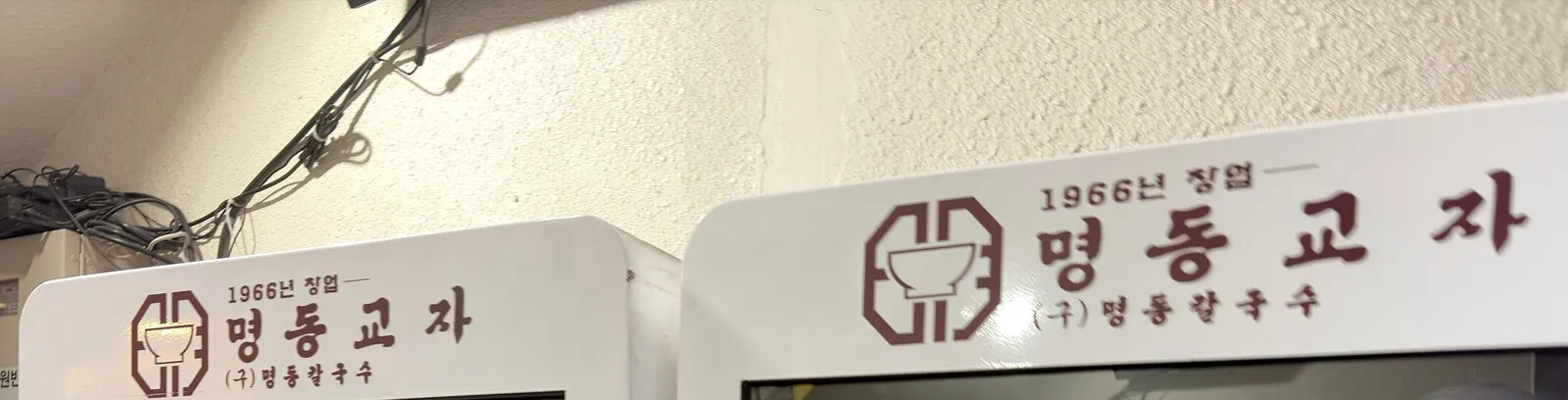
The kiosks by the entrance: “Since 1966, Myeongdong Kyoja, formerly Myeongdong Kalguksu”. Photo: Steve OH.
Once you sit down, the rest is mostly self-service:
- Water and aprons: take them yourself from the fridge of steel water jugs; the sign reads “Self Service: Water & Apron”. An apron is worth it in a light top: the bibim-guksu sauce is red.
- Kimchi: every table has a lidded steel pot of kimchi with tongs, so you serve yourself as much as you want. Cups are stacked on the table, and my table also had a small bowl of rice.
- Extra noodles: a second helping of noodles (sari, 사리) was free; ask the staff.
- Serving robots: two robots carried trays from the kitchen pass, with staff in brown uniforms working the floor.
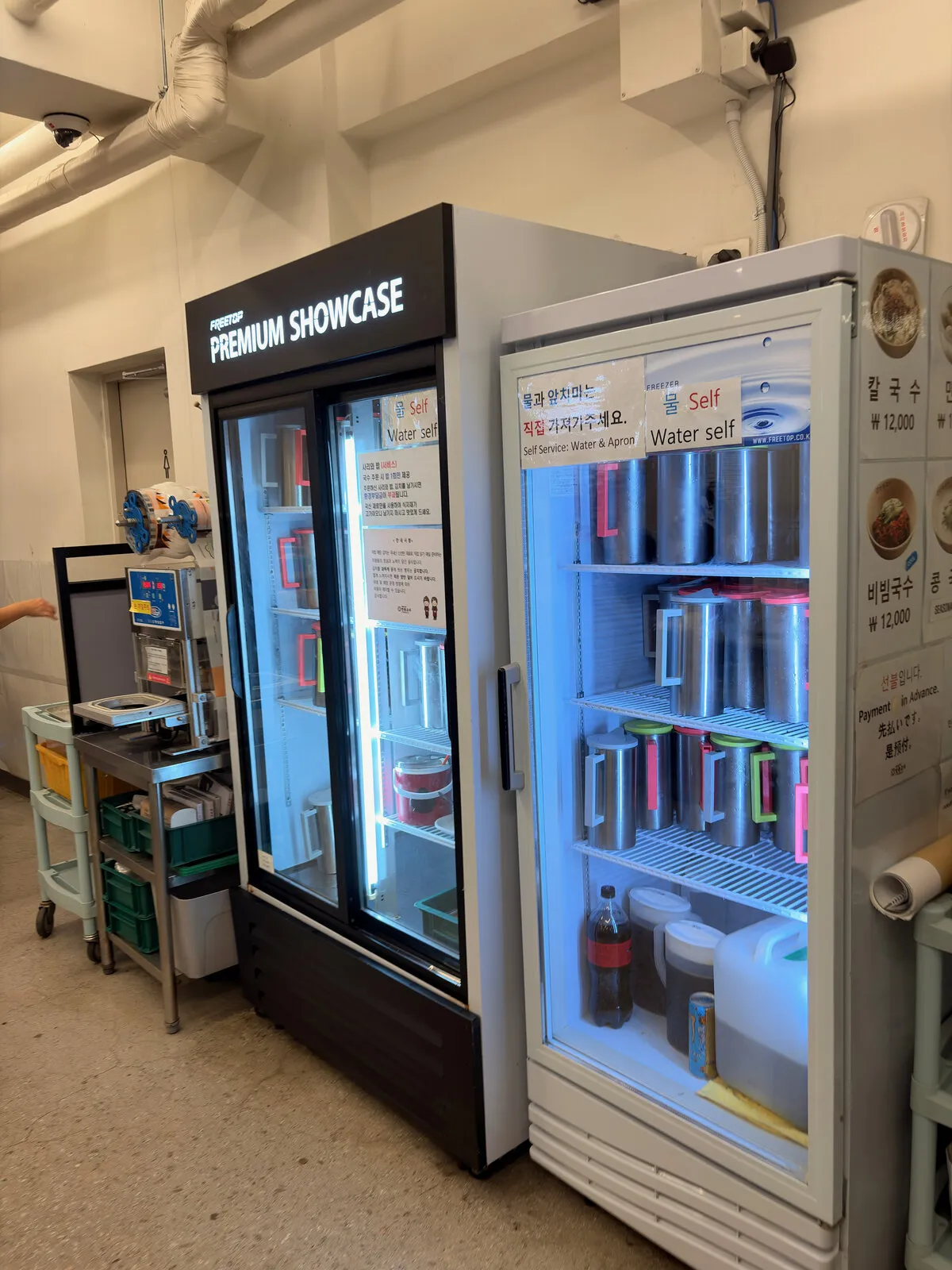
The water and apron fridge, with the menu strip on its side, November 17, 2026. Photo: Steve OH.
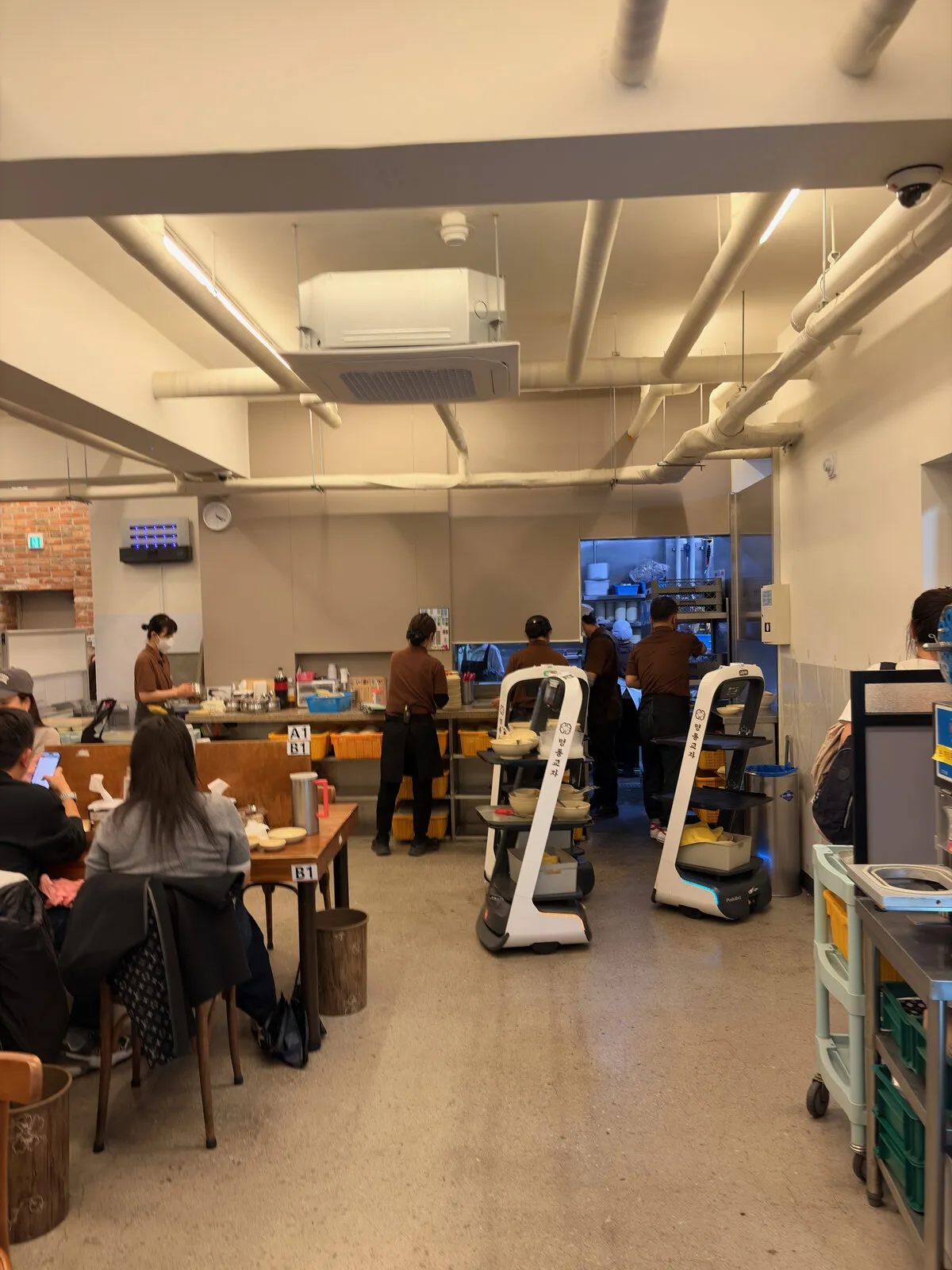
Serving robots at the kitchen pass, main branch. Photo: Steve OH.
What should you order at Myeongdong Kyoja?
Order one kalguksu and one bibim-guksu and eat them back and forth: a spoonful of the hot, mild soup, then a bite of the cold, spicy noodles. That is how I eat here as a Korean, and to me it tastes better than adding dumplings. The menu is only four dishes, one of them summer-only:
| Dish | What it is | Price |
|---|---|---|
| Kalguksu (칼국수) | Knife-cut noodles in chicken broth | ₩12,000 |
| Bibim-guksu (비빔국수) | Cold noodles mixed with a spicy gochujang sauce | ₩12,000 |
| Mandu (만두) | Steamed pork dumplings | ₩13,000 |
| Kongguksu (콩국수) | Cold noodles in soy milk, summer only | ₩13,000 |
Kalguksu and bibim-guksu went up to ₩12,000 on December 1, 2025, and the menu strip showed ₩12,000 for both on November 17. Dumplings and kongguksu have been ₩13,000 since December 1, 2024.
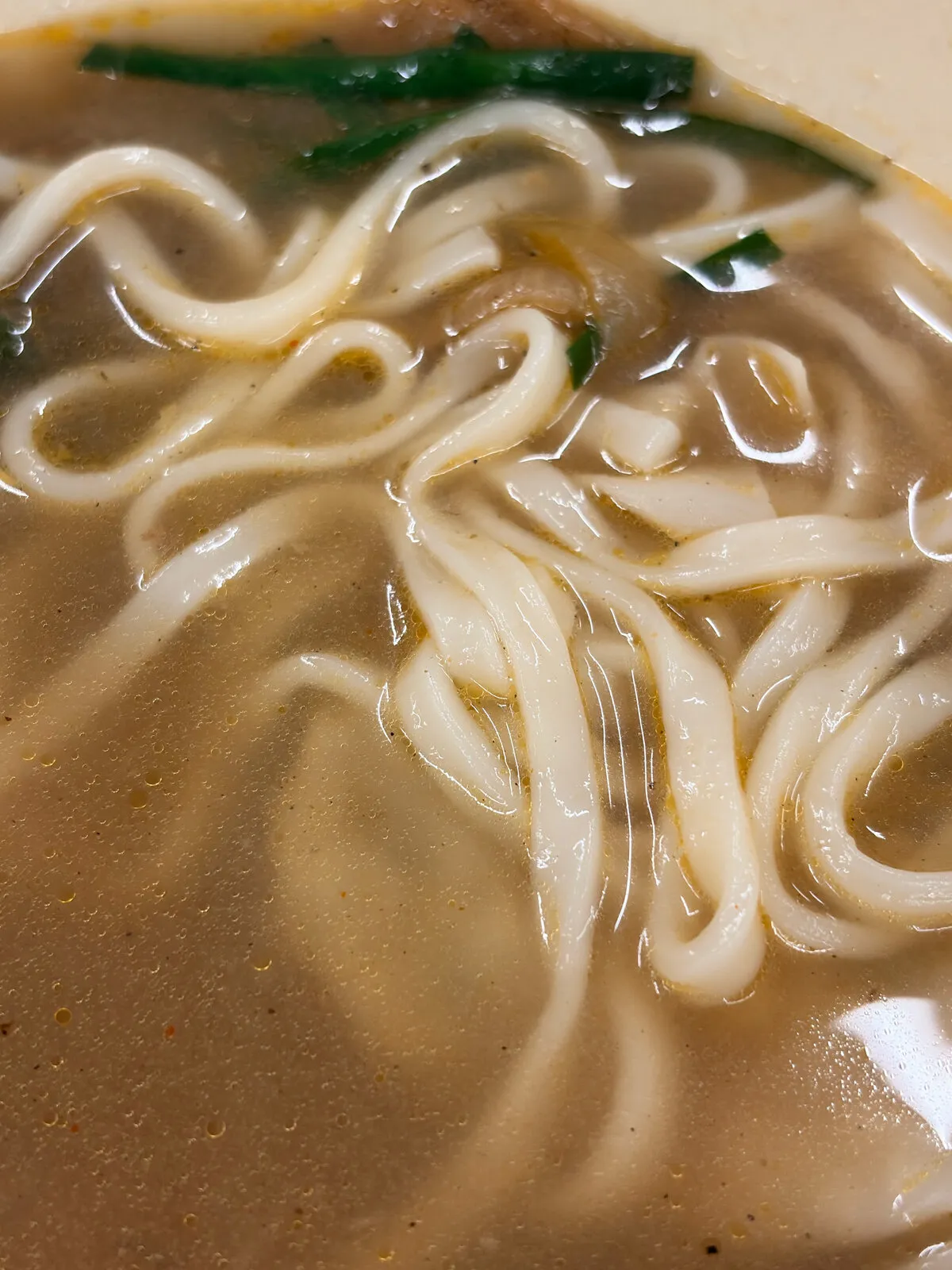
Kalguksu is the dish the shop was built on. The noodles are cooked straight in the chicken broth, so the broth soaks into them, and the topping includes tiny dumplings you won’t find in other kalguksu. Mine came with thin knife-cut noodles in a cloudy beige broth, with green garnish and a little minced meat.
Bibim-guksu is the cold partner. The noodles are made with chlorella, a green algae, and come already mixed with the gochujang sauce, cucumber and sesame oil.
Dumplings are what foreign visitors order a lot, and they sell well. They are round and steamed, with thin skins around pork, chives and sesame oil, and you can also take them to go. If you came for one thing, though, make it the noodles.
Kongguksu is a summer menu: in 2026 it ran from April 15 to October 11, and the menu strip marked it seasonal in November. If you visit in the warm months, it is the cold soup option.
If this is your first trip and you want to know what else to eat in Seoul, see what to eat in Seoul.
How spicy is the food, and why is the kimchi so garlicky?
The kalguksu is mild, but the bibim-guksu and the kimchi can surprise you. Even to my Korean taste the kimchi is a little spicy, and it is very garlicky. That garlic is this shop’s signature: normal Korean kimchi does not taste this strongly of garlic. The operator calls it a fresh, geotjeori-style spicy kimchi served with the kalguksu, and the MICHELIN Guide notes it is made in-house. Take one piece first, then go back for more; the pot stays on your table.
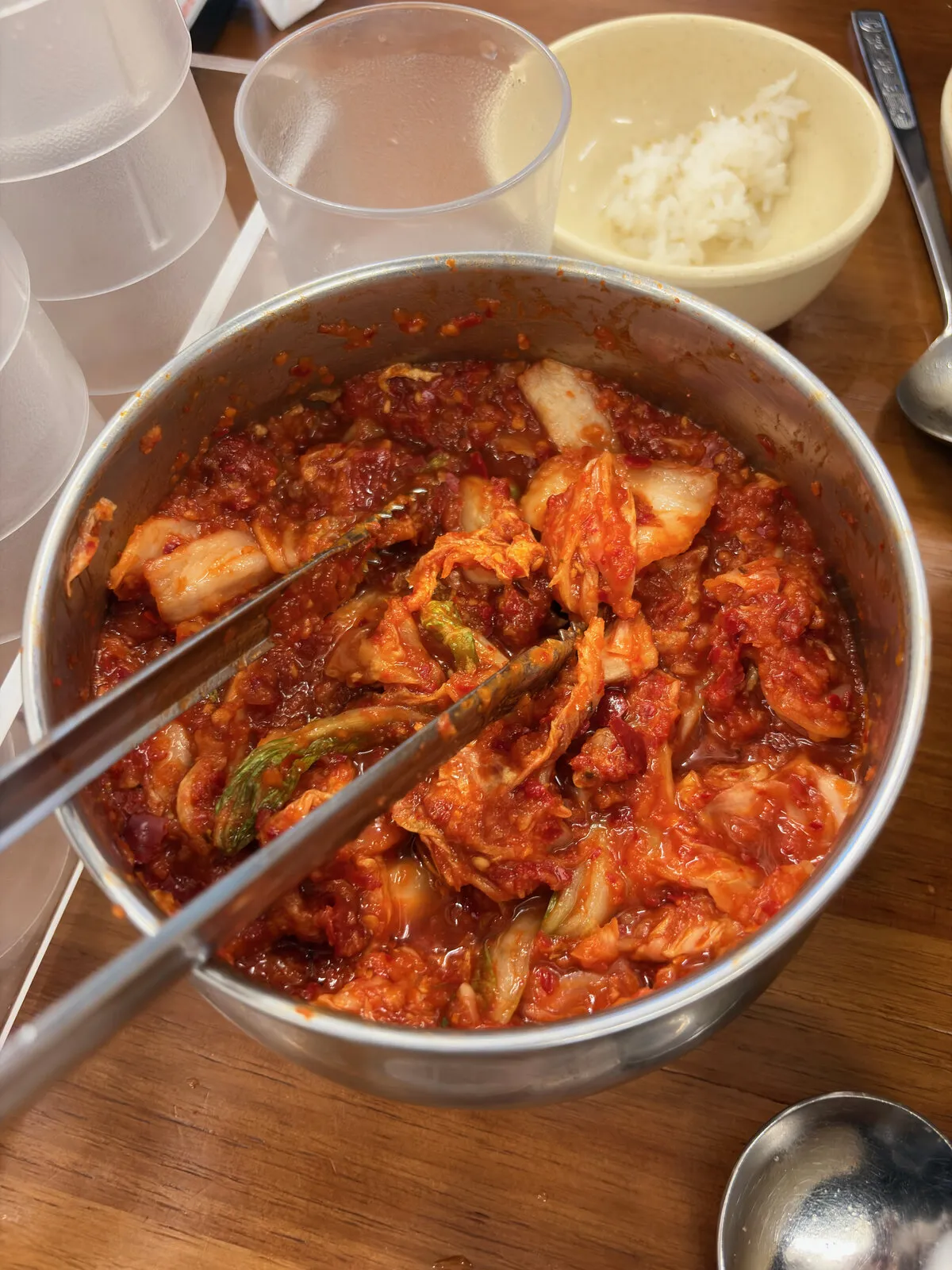
The garlic kimchi, served from a pot on every table. Photo: Steve OH.
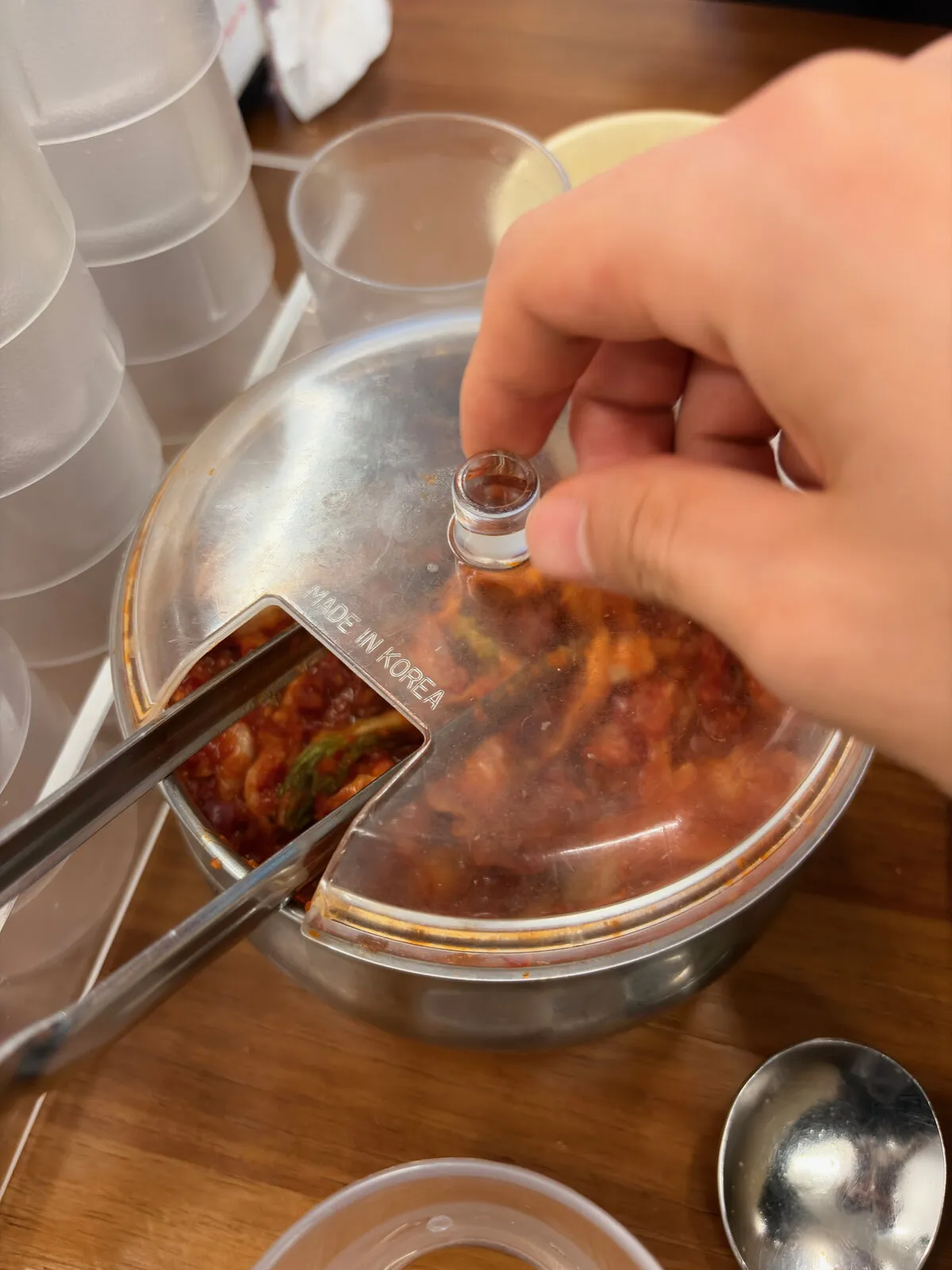
Lift the lid and help yourself. Photo: Steve OH.
Is Myeongdong Kyoja good for solo travelers?
Yes. There are seats for eating alone, and the whole system, kiosk, pay first, one bowl, out, suits one person. When I explain it to foreign friends I say: think of it as Korea’s Ichiran. One famous noodle dish, a short menu, fast turnover, and nobody minds you coming alone.
Why is it called Myeongdong Kyoja, not Myeongdong Kalguksu?
Because “Myeongdong Kalguksu” was copied everywhere. The shop’s history starts in 1966 with a kalguksu restaurant called Jangsujang in a converted hanok in Suha-dong, central Seoul. In the second half of 1969 it moved to Myeongdong, then the busiest district in Seoul, and took the name Myeongdong Kalguksu; January 20, 1970 is its official opening date under that name. Queues ran out the door from the first day, and within a few years new noodle shops all over the country hung up “Myeongdong Kalguksu” signs, until the name meant any cheap noodle place. In 1978 the owners renamed the shop Myeongdong Kyoja (kyoja means dumplings), keeping “formerly Myeongdong Kalguksu” on the sign, and on November 17, 1984 they registered both names. Other shops called Myeongdong Kalguksu, or with names ending in kyoja, are not part of it.
More Food & Drink
Food & Drink
How to Book a Group Dinner in Seoul for 10 or More
How to find a private room or group seating on Naver Map and CatchTable, what deposits and no-show penalties a restaurant can set for a group, how set menus and guaranteed headcounts work, which December nights fill first, and a Korean message you can send as it is.
Food & Drink
How to Book a Seoul Restaurant Without a Korean Phone Number
CatchTable Global, Naver with a passport check, a phone call in Korean or a remote waitlist: what each path asks of a visitor, how deposits and no-show charges work, and the Korean sentences to use.
Food & Drink
Korean Food in Seoul: What to Eat First
Fifteen everyday Korean dishes worth ordering on a first trip: what it is, how to eat it, what the common ones cost in Seoul, how spicy it is, and which ones hide pork, seafood or meat broth.
Reported in person in Seoul on 17 November 2026 by Steve OH, the English name of Myeong OH (오명), Seoulpin's registered publisher and editor. Steve runs Standardpin, a Seoul-based web studio that also builds websites for clinics; that work has no effect on whether or how any clinic appears here. Original notes and photos were edited with AI assistance for formatting and translation, and reviewed by Steve before publishing. How we work
Notes from readers who went