Deoksugung: The Palace Where Korea Tried to Become a Modern Empire
Why a Joseon palace has a neoclassical stone hall, the buildings worth your time, the free English tours, the Seokjojeon museum you can only see with a guide, the guard change at Daehanmun, and the late hours that let you visit after dark.
Walk through Daehanmun, past the painted throne hall, and within a couple of minutes you are standing at a fountain between two columned stone buildings. That clash is the point of Deoksugung. It was the palace of the Korean Empire, the decade when Korea’s last king made himself an emperor and tried to build a modern state, and it kept both halves: wooden halls in the Joseon manner and Western stone ones beside them.
I went on Wednesday, October 7, 2026, a free-admission day. Hours and rules below are from the palace office’s pages, checked the same day.
The short version
| Topic | Details |
|---|---|
| Hours | Entry 9:00 to 20:00; grounds open to 21:00 |
| Closed | Mondays |
| Admission | ₩1,000 for foreign adults 19 to 64; free for foreign visitors 18 and under or 65 and over, and for anyone in hanbok |
| Free days | Every Wednesday since August 5, 2026 |
| Free English tours | Tuesday to Sunday, 10:45 and 13:30, about 45 minutes |
| Seokjojeon museum | Guided visits only; English at 11:50 and 14:50, sign up on site |
| Guard ceremony | At Daehanmun, 11:00 and 14:00, not on Mondays |
| Getting there | City Hall Station (Lines 1 and 2), Exit 2, two minutes on foot |
Why it looks like this
The palace began as an emergency. After the Japanese invasion of 1592 destroyed the palaces in the capital, King Seonjo took over the private manor of Grand Prince Wolsan here in 1593 as a temporary palace. In 1611 it was named Gyeongungung and became an official palace.
Its big moment came three centuries later. In 1897 King Gojong left the Russian legation, where he had taken refuge, moved into Gyeongungung, declared the Korean Empire and took the title of emperor. The palace became the imperial court, and Western-style buildings went up beside the traditional ones. A great fire in 1904 destroyed many of them, and rebuilding began in 1906. In 1907 Japanese pressure forced Gojong to abdicate, and the palace was renamed Deoksugung. Under Japanese rule (1910–1945) it shrank, most of its buildings were demolished and the grounds were made part of a Japanese park development project. Restoration has been under way since 2007.
What to see, in walking order
Daehanmun
The main gate faces City Hall. It was originally the palace’s east gate and took its present name in 1906. It also used to stand 33 meters farther out; it was moved back when Taepyeongno, the boulevard in front, was widened in the 1970s.
Seoul’s Royal Guard Changing Ceremony takes place in front of the gate every day except Monday at 11:00 and 14:00, with guards standing watch at the gate from 10:00 to 15:30. Weather can cancel it. Until November 19, 2026, the palace is also re-laying the roof tiles on the south wall that runs from the gate, so expect scaffolding.
Ten meters inside the gate is the palace map where the free guided tours start: English at 10:45 and 13:30, Chinese at 10:00 and 14:30, Japanese at 9:30 and 16:00, Tuesday to Sunday. They last about 45 minutes and are meant for foreign visitors; a Korean can join only as a foreign visitor’s companion. Groups of ten or more must book. For a self-guided visit, a panel beside the path on October 7 carried a QR code for a smartphone audio guide in Korean, English, Chinese and Japanese, with sign-language video.
Junghwamun and Junghwajeon
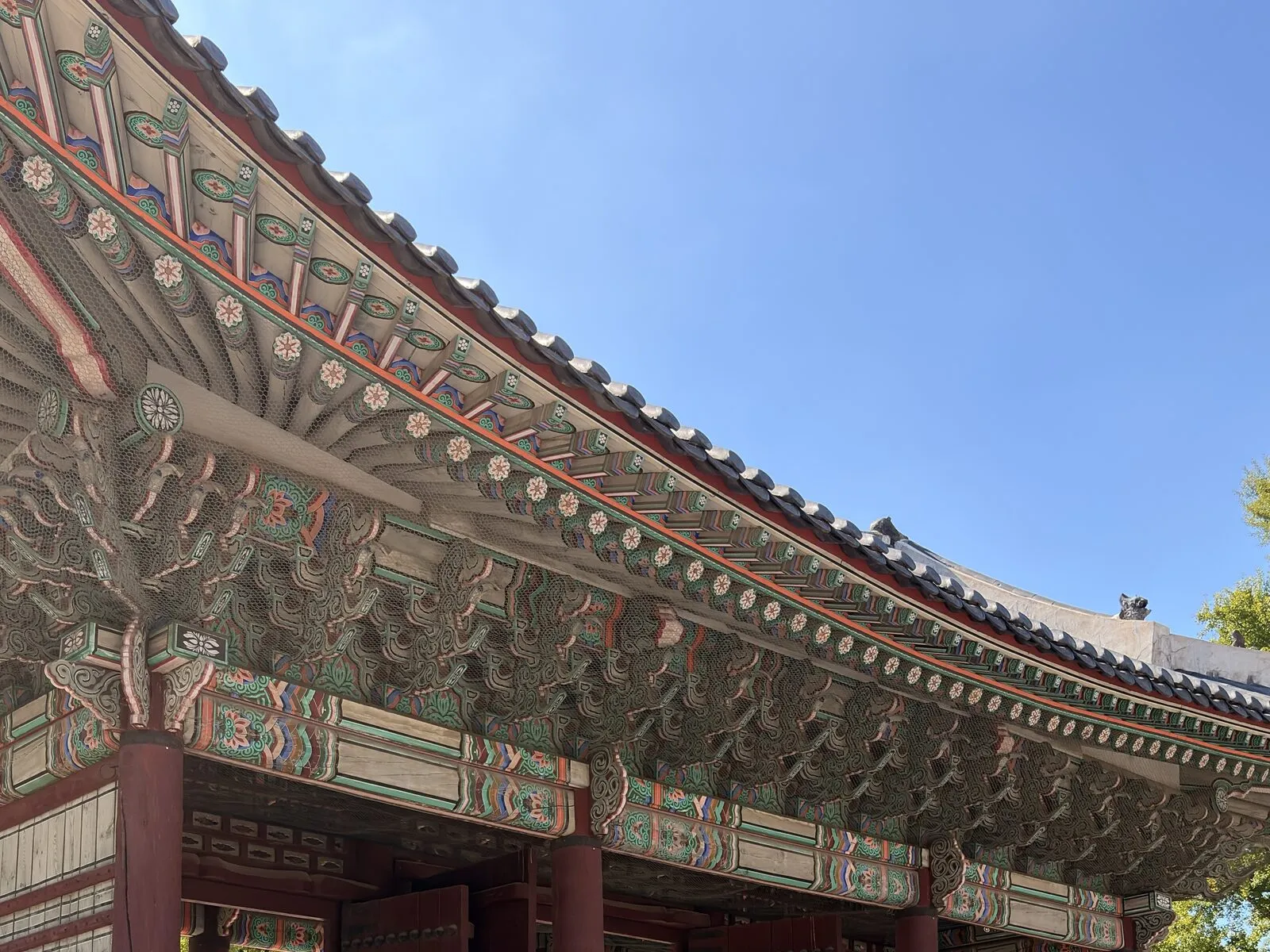
The eaves of Junghwamun, the gate to the throne hall. Photo: Steve OH.
Junghwajeon is the throne hall, where coronations, weddings and audiences with foreign envoys took place. Gojong built it in 1902 with a two-tier roof; it burned in 1904 and came back with the single roof you see now. Look at the stone ramp up the middle of the stairs. Throne halls in Seoul’s other palaces carry phoenixes there; Junghwajeon has two dragons, to mark the dignity of an emperor rather than a king. The stone markers in the courtyard show where officials stood by rank.
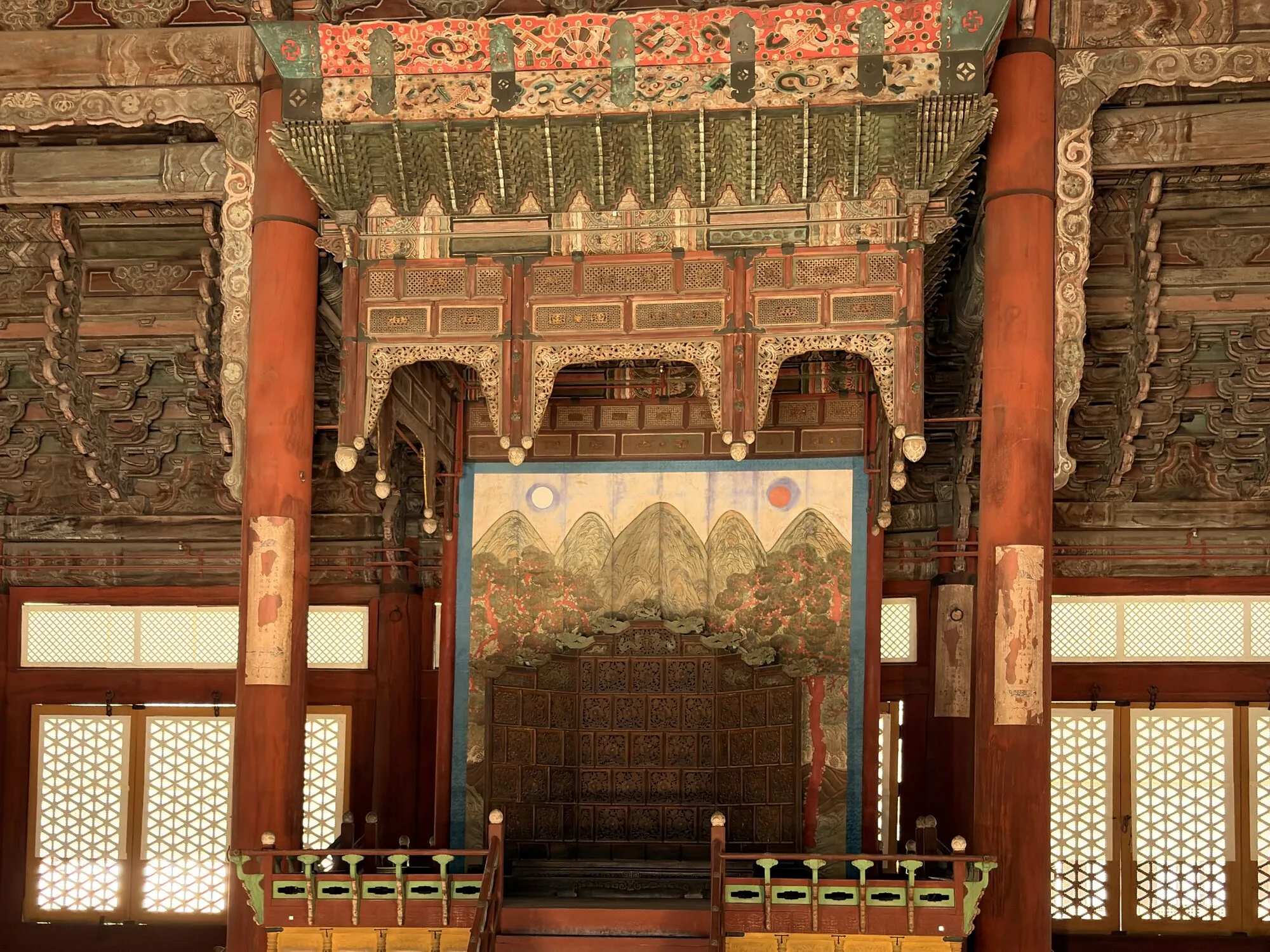
The doors were open on October 7, and you can look in at the throne under its carved canopy, with a screen of mountains, a sun and a moon behind it.
Seokjojeon and the fountain garden
Seokjojeon is the stone building with balconies, designed by the British architect G.R. Harding in the neoclassical style and finished in 1910. It was meant as Gojong’s living quarters and became his reception hall. After 1945 the US–Soviet Joint Commission met there. Today it holds the Daehan Empire History Museum.
You can only go in with a guide. The Korean-language sessions open for online booking a week ahead, 15 people each. The English sessions at 11:50 and 14:50, Tuesday to Sunday and on public holidays, are taken on site only; on October 7 a sign at the gate put the limit at 20 foreign visitors each, with a waiting list at the museum’s first-floor entrance. Bring ID; the sign said staff may ask for it.
The other stone building on the fountain garden is MMCA Deoksugung, part of the National Museum of Modern and Contemporary Art. It needs its own ticket, and it stays open to 21:00 on Wednesdays and Saturdays, free after 18:00.
Hamnyeongjeon, Deokhongjeon and Gwangmyeongmun
Hamnyeongjeon, the emperor’s sleeping quarters, is where Gojong lived until he died in 1919. Behind it is a terraced garden with decorated chimneys. Next door, Deokhongjeon was his reception hall; its interior mixes a chandelier with phoenix-painted beams. The gate in front, Gwangmyeongmun, was moved away by the Japanese colonial government in 1938 and put back only in 2018.
Jeukjodang, Junmyeongdang and Seogeodang
Seogeodang and Jeukjodang are the palace’s original buildings. Seogeodang, where King Seonjo stayed during the war, is the only two-story wooden building left in Deoksugung, and it has none of the painted decoration on the other halls, so it looks plain next to everything else. Two kings, Gwanghae and Injo, were crowned in Jeukjodang, which also served as Gojong’s throne hall until Junghwajeon was built. Junmyeongdang, joined to it by a corridor, was a kindergarten for Gojong’s daughter, Princess Deokhye, in 1916.
Jeonggwanheon
A pavilion that is half Korean and half Western, with Romanesque columns inside and a railing carved with deer, pines and bats. The Annals of Emperor Gojong record it as a temporary shrine for royal portraits.
Dondeokjeon and Jungmyeongjeon
Dondeokjeon, a European-style brick hall built in 1902 for state guests, is where Emperor Sunjong took the throne in 1907. It was demolished in the 1920s and rebuilt in 2023.
Jungmyeongjeon, built in 1897 as the imperial library, is where the Korea–Japan Treaty of 1905, which stripped Korea of its diplomatic rights, was forced through. It is now an exhibition hall, open 9:30 to 17:30.
When to go
- Wednesday: admission is free, and the MMCA is free after 18:00.
- After dark: entry runs to 20:00 and the grounds stay open to 21:00, every day the palace is open. The stone buildings and the city lights around them make Deoksugung one of the best palaces in Seoul for an evening walk.
- For a tour: 10:45 for the grounds, then the 11:50 Seokjojeon session; or 13:30 and 14:50. Arrive early for the Seokjojeon waiting list.
- Not Monday. The palace, Seokjojeon and the MMCA are all closed.
For the blocks around the palace, from City Hall’s basement gallery to the Seoul Museum of Art along the stonewall road, see our walk from City Hall to Deoksugung.
More K-Culture
K-Culture
Changdeokgung Secret Garden Tickets and Entry Times
The garden needs its own timed ticket on top of palace admission, and the timed entry is at an inner gate 15 minutes' walk from the main gate. How to book, what it costs, the English sessions and how early to arrive.
K-Culture
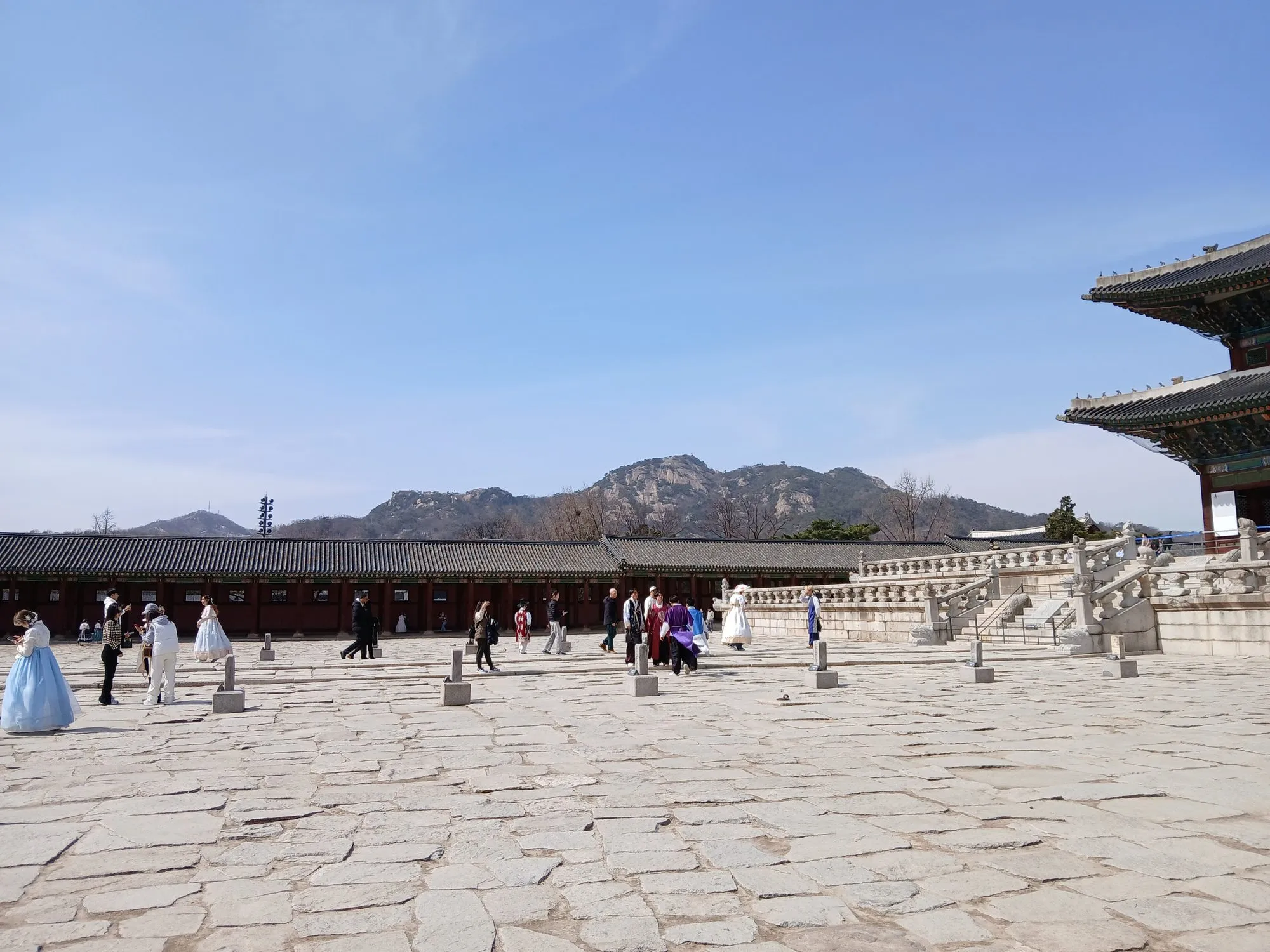
Gyeongbokgung in Hanbok: What Gets You In Free, and What Doesn't
The dress code behind free palace entry, what Seoul's royal palaces and Jongmyo charge everyone else, when the guards change, how night-viewing tickets work, and how to judge a hanbok rental before you pay.
K-Culture
Jongmyo Entry Days and English Tours
When the English sessions run, which days you must enter with a guide and which days you can walk in, what it costs, and the free independent-entry period from October 29 to November 15, 2026.
Steve OH edits Seoulpin. Steve runs Standardpin, a Seoul-based web studio that also builds websites for clinics; that work has no effect on whether or how any clinic appears here. Articles are drafted with AI assistance from the sources listed and reviewed by Steve before publishing. How we work