How to Order and Eat Korean BBQ in Seoul
Which cuts to order and how to say them, how to read prices by the gram, who grills, how to wrap ssam, and what to do if you are on your own.
At a Korean barbecue restaurant in Seoul you order raw meat by the portion (인분, inbun), it is cooked on a grill at your table, and you eat it with free side dishes, often wrapped in a lettuce leaf with a dab of ssamjang paste. Some restaurants grill for you; at many you grill yourself. In September 2026 pork belly, the default order, averaged ₩21,321 per 200 g in Seoul restaurants. Some restaurants will not sell a single portion, so plan on ordering two to start. There is no tipping, side dishes are refilled at no charge, and the meal usually ends with cold noodles, fried rice or a bowl of stew.
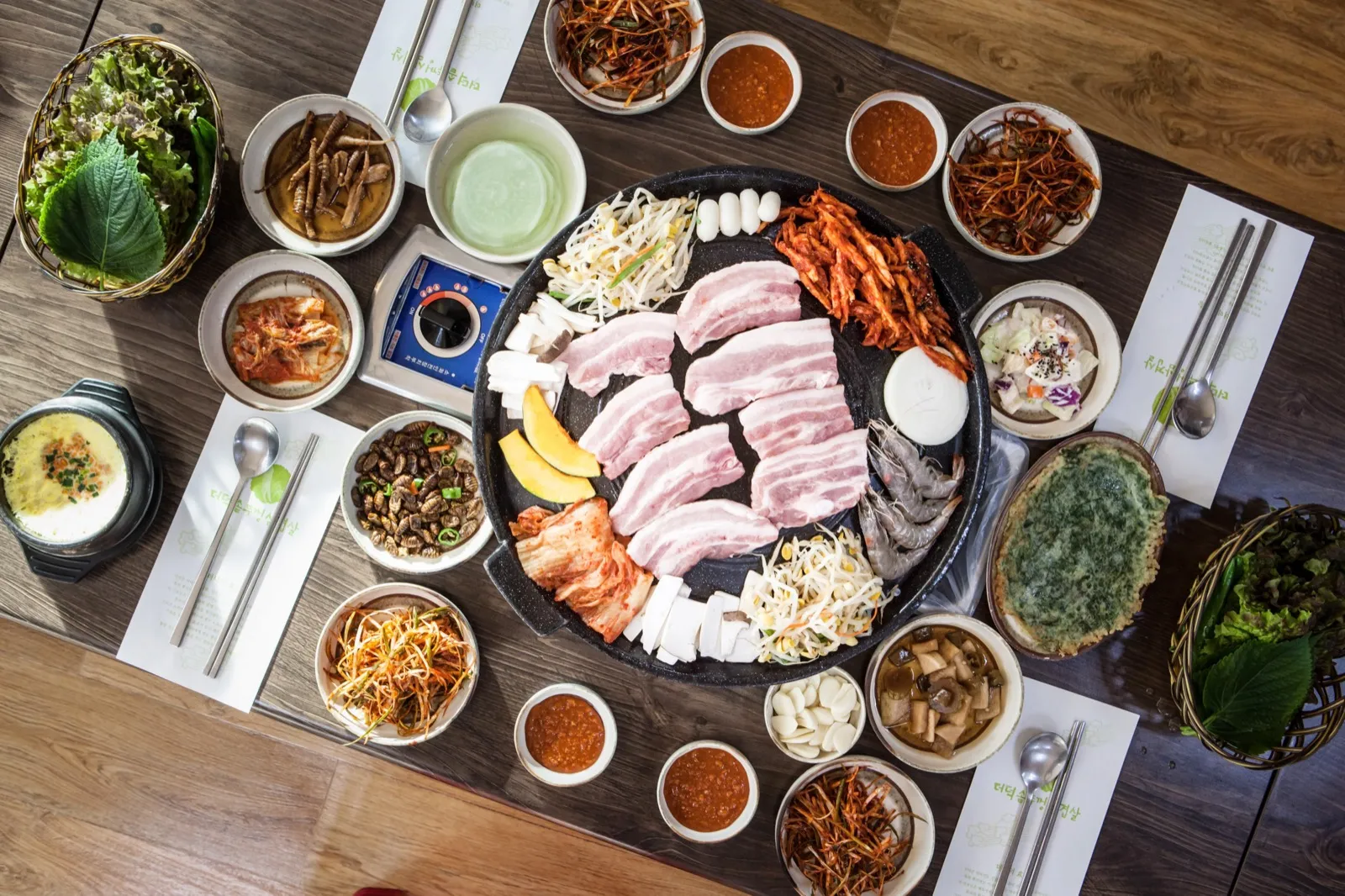
How do you order at a Korean BBQ restaurant?
Sit down, pick one or two cuts from the menu, and tell the server the cut and the number of portions: “Samgyeopsal i-inbun juseyo” (삼겹살 2인분 주세요) means “two portions of pork belly, please”. If your table has an ordering tablet, choose the cut and the number of portions on it instead; the same tablet may also take payment at the end (see below). First, put your coat and bag inside your chair: many restaurant seats open up as storage boxes, so your things do not soak up the smell of the grill.
The meat arrives raw with the side dishes, sauces and lettuce. You can add more portions, a different cut, rice, stew or noodles at any point. To get attention, press the call button on the table or say “Yeogiyo!” (여기요, “Excuse me!”).
If the menu is only in Korean, Papago’s camera translation recognises Korean food names and pulls up the tourism organization’s description of the dish.
Which cuts should you order?
Start with samgyeopsal (pork belly), the default order: two portions for two people, then one portion of moksal (pork shoulder) or a marinated cut if you are still hungry. Pork is the everyday barbecue; beef, such as chadolbagi or galbi, costs more. Ordering in rounds is normal and avoids leftovers. These are the cuts you will see most, with the names as they appear on Korean menus.
| On the menu | Say | What it is |
|---|---|---|
| 삼겹살 | samgyeopsal | Pork belly, fatty and tender. Eaten with ssamjang, or sesame oil and salt, often wrapped in lettuce with garlic (KTO) |
| 목살 | moksal | Pork shoulder, leaner and chewier than belly, usually with coarse salt or sesame oil and salt (KTO) |
| 항정살 | hangjeongsal | A finely marbled neck-to-shoulder cut; a pig yields only about 200 g (KTO) |
| 돼지갈비 | dwaejigalbi | Pork ribs marinated in soy sauce or red chili paste (KTO) |
| 양념갈비 / 소갈비 | yangnyeom galbi / so-galbi | Beef short ribs in a sweet soy marinade, cut into bites and eaten plain or in lettuce or perilla leaves (KTO) |
| 우대갈비 | udaegalbi | Beef short rib cut along one long bone, unlike LA galbi, which is cut across several bones (KTO) |
| 차돌박이 | chadolbagi | Thin, fatty brisket that cooks almost the moment it touches the grill (KTO) |
양념 (yangnyeom) in front of a cut means it comes marinated.
How much does Korean BBQ cost in Seoul?
Pork belly averaged ₩21,321 per 200 g in Seoul restaurants in September 2026, according to the Ministry of the Interior and Safety’s dine-out price survey, published on the Korea Consumer Agency’s T-Price portal. The survey records portions of roughly 100 g to 250 g and converts them to 200 g; the average portion as served cost ₩18,154. Its figures are provisional. On the same survey a bowl of naengmyeon cost ₩12,692 in Seoul. At those averages, two portions of pork belly as served and one bowl of naengmyeon come to about ₩49,000 for two people, before drinks. The survey does not track beef, which costs more: the tourism organization notes that pork ribs are more affordable than beef ribs.
Read the menu by weight, not just by portion. Under Korean food-hygiene rules, summarised on the government’s Easylaw page, every restaurant must post a price list that includes VAT, and restaurants of 150 m² or more must post it both inside and outside. On that list, meat must be priced per 100 g, and a per-portion price must also state the portion’s weight, in the form “갈비 100그램 ○○원 (1인분 150그램 △△원)”: galbi, so many won per 100 g, one portion of 150 g for so many won. In practice some menus show only a portion price; if no weight is given, ask “Myeot geuraem-ieyo?” (몇 그램이에요?, “How many grams?”).
The posted price is what you pay. Since September 1, 2026, a restaurant that posts no price list or charges more than its posted price faces a five-day suspension on the first offence, up from a correction order, Yonhap reported.
What does hanwoo on the menu mean?
한우 (hanwoo) is beef from Korea’s native cattle, and restaurants have to tell you whether the beef you are eating is hanwoo. Korean origin-labelling law, set out on Easylaw, requires restaurants to label the origin of the beef and pork they serve. The quality service’s leaflet adds that domestic beef must also name its type: 한우 (hanwoo), 육우 (yugu, domestic beef cattle) or 젖소 (jeotso, dairy cattle). Look for a line such as “쇠고기: 국내산 한우” (beef: domestic hanwoo) on the menu or on the origin board on the wall; imported beef carries its country, such as 호주산 (Australian) or 미국산 (American).
Grades are the other number you may see. All slaughtered cattle in Korea are graded, and the Hanwoo Board explains that the meat-quality grade is set by marbling, meat colour, fat colour, texture and maturity. The grade labels run 1++, 1+, 1, 2 and 3, plus 등외 (out of grade). Only 1++ beef carries an extra marbling score of 9, 8 or 7, so you may see “1++(9)” on a hanwoo menu.
Do you grill the meat yourself?
At many restaurants you grill the meat yourself with the tongs and scissors brought to the table; at some, staff grill it and tell you when it is ready, the tourism organization’s guide says. If you are not sure which kind of place you are in, ask: “Guwo juseyo?” (구워 주세요?, “Could you grill it for us?”). Most tables have a ventilation hood that draws the smoke away.
If you are grilling yourself:
- Wait until the grill is hot before the meat goes on, and lay pieces flat without crowding.
- Turn pork belly when the underside has browned, then cut it into bite-size pieces with the scissors and cook the pieces through.
- Thin chadolbagi needs seconds per side; eat it straight off the grill.
- Cook unmarinated cuts before marinated ones. Sweet marinades burn and stick; before switching, ask for a fresh grill plate with “Bulpan galajuseyo” (불판 갈아주세요, “Please change the grill plate”).
- Put garlic and green onion on the grill alongside the meat, as the tourism organization suggests for short ribs.
How do you eat Korean BBQ?
Dip a piece in one of the sauces, or wrap it. The usual dips are salt, sesame oil, ssamjang (a seasoned red chili and soybean paste) and myeolchijeot, salted anchovies, with sides such as pachae (sliced green onion salad), pickled onion, pickled vegetables, sliced radish, garlic and peppers, as the Korean Food Promotion Institute lists them.
To make ssam, lay a lettuce or perilla leaf in your palm, add a piece of meat, a little ssamjang and a slice of garlic or some green onion salad, fold it and eat the whole parcel in one bite, as the tourism organization’s guide describes. Marinated cuts need no sauce.
Soju is the classic drink with pork belly, as the institute’s essay on ssam shows. Order it by the bottle: “Soju han byeong juseyo” (소주 한 병 주세요, “One bottle of soju, please”). Bring your passport if you look young; the age rule is in our convenience store guide.
Are the side dishes free?
Yes. Extra side dishes and water cost nothing. Ask for more lettuce, kimchi or any side dish with “Igeo deo juseyo” (이거 더 주세요, “More of this, please”) while pointing at the empty plate. Some restaurants have a self-service station for water and side dishes; if you see one, that is where the refills are. Rice (공기밥, gonggibap), stew and noodles are menu items with their own price.
What do you order after Korean BBQ?
Cold noodles (naengmyeon), fried rice made on the grill, or soybean paste stew; the Korean Food Promotion Institute calls the noodles or fried rice Korean barbecue’s “dessert”. Naengmyeon comes either in an icy beef broth (물냉면, mul-naengmyeon) or without broth, mixed with a red chili sauce (비빔냉면, bibim-naengmyeon). Many people also eat a bite of hot meat with a mouthful of cold noodles.
Fried rice (볶음밥, bokkeumbap) is made on the grill in the fat left from the meat, usually with kimchi and laver and sometimes flying-fish roe or cheese; ask for it with “Bokkeumbap juseyo” (볶음밥 주세요). The meal is finished, the institute says, only when the last grains are scraped off the plate. Doenjang-jjigae, soybean paste stew, is the other way to finish, and chadolbagi can go into it. Order these when you are down to the last of the meat.
Can you eat Korean BBQ alone?
Sometimes. Some barbecue restaurants take orders of two portions or more only, and some will not seat a solo diner at all. Neither is penalised under current law, the JoongAng Ilbo reported in September 2025, and only about 10% of Korea’s restaurants offered a one-person menu in March 2025.
Our advice if you are on your own: ask at the door, “Honja-inde gwaenchanayo?” (혼자인데 괜찮아요?, “I’m alone, is that OK?”), and be ready to order two portions. Go early or late, outside the dinner rush, when a four-person table is easier to give up. A menu that lists 1인 (one-person) sets is a good sign.
How do you pay?
Usually at the counter by the door as you leave: say “Gyesan halgeyo” (계산할게요, “I’ll pay now”). At some tables you pay on the ordering tablet, or staff bring the bill. There is no need to tip. To split the bill, tell the cashier “Nanwoseo gyesan halgeyo” (나눠서 계산할게요, “We’ll pay separately”).
To find a barbecue restaurant and get there, see our guide to Naver Map in English.
More Food & Drink
Food & Drink
Korean Convenience Stores: How GS25, CU, 7-Eleven and emart24 Work
Paying by card, the hot-water station for cup ramyeon, opening a triangle kimbap, 1+1 and 2+1 deals, the age rule for beer, and the ATMs, parcel kiosks and tax refunds some branches add.
Food & Drink
Neungdong Minari in Seongsu: Is the Minari Beef Soup Worth the Line?
I went on a Friday night in October and paid my own bill. How long the line really takes, what to order, what minari tastes like and who may not like it, prices, hours, takeout, and the walk from Seongsu Station Exit 4.
Food & Drink
Gwangjang Market Street Food: Hours, Dishes and How to Order
Hours, the walk from Jongno 5-ga Station, what bindaetteok, mayak gimbap, yukhoe and kalguksu are, how the stalls work, and how to avoid being overcharged.
Steve OH edits Seoulpin. Steve runs Standardpin, a Seoul-based web studio that also builds websites for clinics; that work has no effect on whether or how any clinic appears here. Articles are drafted with AI assistance from the sources listed and reviewed by Steve before publishing. How we work