Money in Seoul: ATMs, Exchange and When You Still Need Cash
Which ATMs take a foreign card, the screen that quietly costs you money, where to change cash and what your passport is for, the customs line at US$10,000, and the few places a card won't do. With notes for Taiwan-issued cards.
Pay for most things in Seoul by card, and carry a small amount of won in cash. To get that cash, use a bank ATM marked “Global ATM” with your own debit card, or change notes at a bank or a certified exchange booth with your passport in hand. When an ATM or card terminal offers to charge you in your home currency, decline and pay in won. Bring more than US$10,000 in cash and you must declare it at the airport.
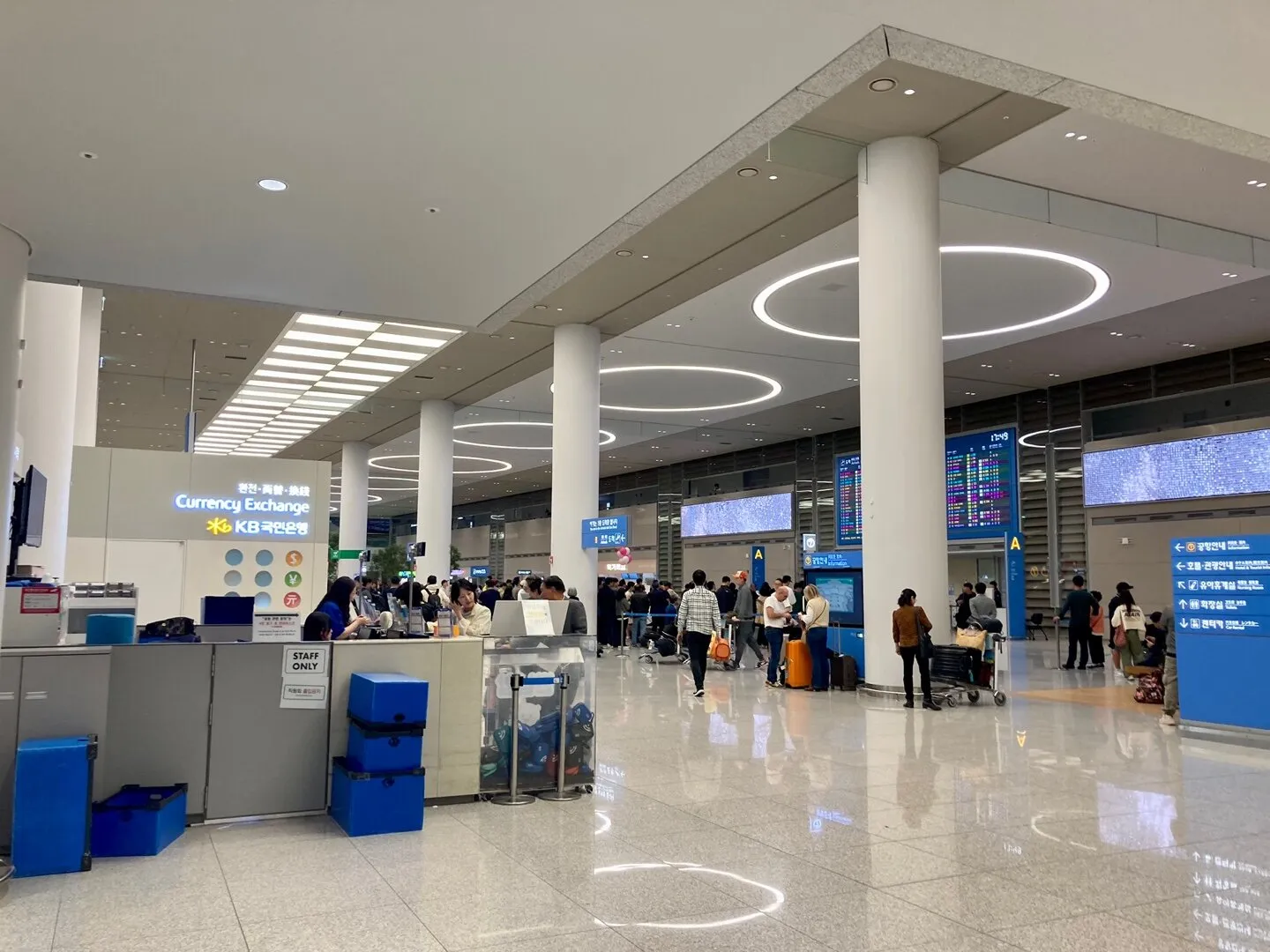
Which ATMs in Seoul take foreign cards?
Look for a machine labelled “Global ATM.” JCB’s list of partner ATMs puts the rule plainly: in Korea, cards issued abroad work only at Global ATMs. Its Korean partners include KB Kookmin, Shinhan, Woori, Hana, NH, IBK, Standard Chartered and BC Card, plus Hyosung TNS, an ATM operator. Visit Seoul says these machines are common, marked with the “Global” sign or the logos of the card networks they take, and that most offer English, Chinese and Japanese.
Hana Bank’s ATM FAQ names the card logos its Global ATMs accept: Mastercard, Maestro, Cirrus, Visa, Plus, JCB and UnionPay. Match a logo on the back of your card to one on the machine. Our advice: withdraw at a bank branch rather than a convenience store, since Visit Seoul notes that convenience store ATMs often charge higher fees. Most ATMs run until 11 p.m.; many are open 24 hours. For finding a store with an ATM, see our convenience store guide.
What will an ATM withdrawal cost?
Up to three charges can stack: the machine’s own fee, your home bank’s fees, and a conversion markup if you accept one (see below). UnionPay notes that some machines abroad add a surcharge and show it, with how it’s charged, on the screen; that screen is where to read it. Your own bank also caps how much you can take out. Taishin Bank in Taiwan, for example, allows NT$20,000 per withdrawal and NT$100,000 a day, counting withdrawals at home. If the machine charges per withdrawal, take out more at once.
Use a debit card, not a credit card, if you can. UnionPay tells its cardholders the same, because interest applies when you withdraw with a credit card.
Should you pay in won or your home currency?
Pay in won, every time. When a screen offers to bill you in dollars, yen or New Taiwan dollars, that is dynamic currency conversion, which comes with its own exchange rate and added fees. Visa requires any merchant or ATM offering it to show the rate and the markup, to let you accept or decline, and not to choose for you or nudge you with bigger fonts or colours. If the screen hides those details or pushes you, Visa recommends declining.
Where should you exchange cash: airport, bank or money changer?
Change a small amount at the airport and the rest in the city. Seoul’s city government lists three places that change foreign currency into won: bank exchange counters at the airport, banks in downtown Seoul, and private exchange offices. Visit Seoul says banks usually give travellers the best rates.
- At Incheon Airport. Bank counters are open on arrival. In Terminal 1, the airport lists a 24-hour KB Kookmin counter near Arrival Hall B on the 1st floor and 24-hour Woori Bank counters near exits 6 and 11 on the same floor. The Korea Federation of Banks notes that airport branches apply different exchange margins from ordinary branches, because they cost more to run.
- At a bank in the city. VisitKorea puts bank hours at 9 a.m. to 4 p.m. on weekdays, and warns that some places may refuse old banknote designs.
- At a private money changer. Visit Seoul says they are usually located where international visitors go; most open from 6 a.m. to 9 p.m., the city says. Visit Seoul tells visitors to use only booths that show a “Certified” sign with currency symbols, and to avoid uncertified ones. For changers in Myeongdong and the exchange certificate they issue, see our Myeongdong guide.
What is your passport for when you change money?
To identify you: the city says you must show a passport or residence card to exchange currency. It also caps a single exchange at US$10,000; going over that needs a customs declaration. Keep the paperwork. When you change won back before leaving, a bank without your exchange receipts will do up to the equivalent of US$10,000 and record it in your passport, according to the Korea Federation of Banks; with the receipts, you can change back up to the amount on them. The changer’s rules are in our Myeongdong guide. Your passport also gets you the shop tax refund, covered in our tax refund guide.
How much cash can you bring into Korea?
Up to US$10,000 with no paperwork. Korea Customs Service says that if you arrive with foreign currency, won notes or cheques worth more than US$10,000 in total, you must declare it to Customs, which issues a Certificate of Foreign Currency Declaration. Do it at the airport: Customs can’t issue the certificate once you’ve entered the country. Failing to declare can bring a fine or up to a year in prison.
Leaving is the mirror image. Visitors carrying less than US$10,000 don’t report anything. If you carry out more, but no more than you declared when you arrived, you need no new report, only that certificate. Keep it with your passport.
Can you pay by card everywhere in Seoul?
Almost. The city says credit cards work in most shops, restaurants, hotels and tourist sites, for any amount, small or large, and that Visa, Mastercard and American Express are taken. VisitKorea adds that some shops still don’t, so ask before ordering at small places. Taxis take foreign cards; our airport guide lists which networks each ride from Incheon accepts.
Where do you still need cash?
In a handful of places a visitor meets in the first days:
- Loading a T-money card. Top-ups at stores and station machines are in won cash; details in our T-money guide.
- Some airport buses. At Terminal 1, several Airport Limousine routes take cash, a transit card or a ticket, but no card on board; see the airport guide.
- Street stalls and markets. Only about a third of Myeongdong’s licensed stalls had card terminals by 2024 (Myeongdong guide), and card payment at Gwangjang Market varies from stall to stall (Gwangjang guide).
For these, ₩1,000 and ₩10,000 notes are the useful ones. Korea’s notes are ₩1,000, ₩5,000, ₩10,000 and ₩50,000, and its coins ₩10, ₩50, ₩100 and ₩500.
Do Taiwan-issued bank cards work at Korean ATMs?
Yes, at ATMs showing Visa/Plus or Mastercard/Cirrus, and some banks (E.SUN, for one) require you to switch on the overseas function before you fly. Taiwan’s own chip-card network, run by the Financial Information Service Co. (FISC), lists cross-border withdrawals only in Japan, Hong Kong and Macau. In Korea, a Taiwanese debit card works the same way as any foreign card:
- Find the right logo. Taishin Bank says its ordinary chip debit cards and Visa debit cards use ATMs showing Visa or Plus, and its Mastercard debit cards use ATMs showing Mastercard or Cirrus. In Korea, that means a Global ATM.
- Switch on the overseas function and set a 4-digit PIN at home. For its digital-account debit cards, E.SUN Bank tells customers to turn on the magnetic-stripe cross-border function before leaving Taiwan and to set a 4-digit stripe PIN at one of its ATMs. Abroad, at a Cirrus or Plus machine, choose the credit card or Visa/Mastercard option and enter that 4-digit PIN, not your usual 6–12 digit chip PIN. Three wrong tries lock it, and only an E.SUN ATM can reset it.
- Ask your own bank. Other Taiwanese banks set this up differently and set their own limits, as with Taishin’s NT$20,000 per withdrawal above.
Taiwan Pay also works in Korea, for paying, not for cash. FISC’s Taiwan Pay page for Korea says you can scan to pay at shops showing the TWQR or Taiwan Pay mark, from your bank’s app linked to a debit card or account, without the 1.5% overseas fee a credit card charges; you may tell the cashier you’re paying with Paybooc. The cross-border function has to be switched on first.
Should you bring New Taiwan dollars or won?
Bring won, or a card. Bank of Taiwan quotes buying and selling rates for Korean won cash, so you can buy won before you leave. Some Korean banks change New Taiwan dollar notes: Hana Bank’s daily rate board quotes them. But it applies a much wider margin to them than to US dollars or yen, so you lose more on every note you change in Seoul.
More Practical Seoul
Practical Seoul
Seoul in November 2026: CSAT Day, Palace Hours and the Dance Festival
Flights stop from 13:05 to 13:40 for the exam's English listening test on November 19, the palaces close earlier, and the Seoul Dance Festival runs to November 29. Dates, hours and the big exhibitions on.
Practical Seoul
Seoul Autumn Foliage: When It Peaks and Where to Go
When Seoul's leaves turn this year, and a one-day route through palaces and ginkgo streets you can reach by subway.
Practical Seoul
The Best eSIM for Korea Depends on One Question
Data-only eSIM, a prepaid line with a Korean 010 number, pocket Wi-Fi or your carrier's roaming pass: what each one does, what SK Telecom, KT and LG U+ charge, and which airport counters stay open all night.
Steve OH edits Seoulpin. Steve OH is the English name of Myeong OH (오명), Seoulpin's registered publisher. Steve runs Standardpin, a Seoul-based web studio that also builds websites for clinics; that work has no effect on whether or how any clinic appears here. Articles are drafted with AI assistance from the sources listed and reviewed by Steve before publishing. How we work
Notes from readers who went