Silbiok in Seongsu: A Beef and Seaweed Hot Pot Eaten as a Course
I went on a Saturday night in October and paid my own bill. What to order, what it costs at lunch and at dinner, how the waitlist kiosk works, and how to find the basement door 171 m from Seongsu Station.
Yes, go to Silbiok (실비옥) if you want a meal in Seongsu that Koreans eat, not one built for visitors. Order the beef seaweed hot pot (소고기미역전골) and eat it as a course from one pot: beef brisket and seaweed soup first, then hand-cut kalguksu noodles and sujebi dough cooked in the broth, then porridge made in the same pot. It is not spicy and the portions are large. A serving costs ₩13,900 at dinner and on weekends and ₩11,900 at weekday lunch, with a minimum of two servings. Silbiok opens every day from 11 a.m. to 11 p.m. (closed 3 to 5 p.m. on weekdays) in the basement of THE LIV Sejong Tower, 171 m from Exit 3 of Seongsu Station. I ate there on Saturday, October 17, 2026, paid for everything myself, and was not invited.
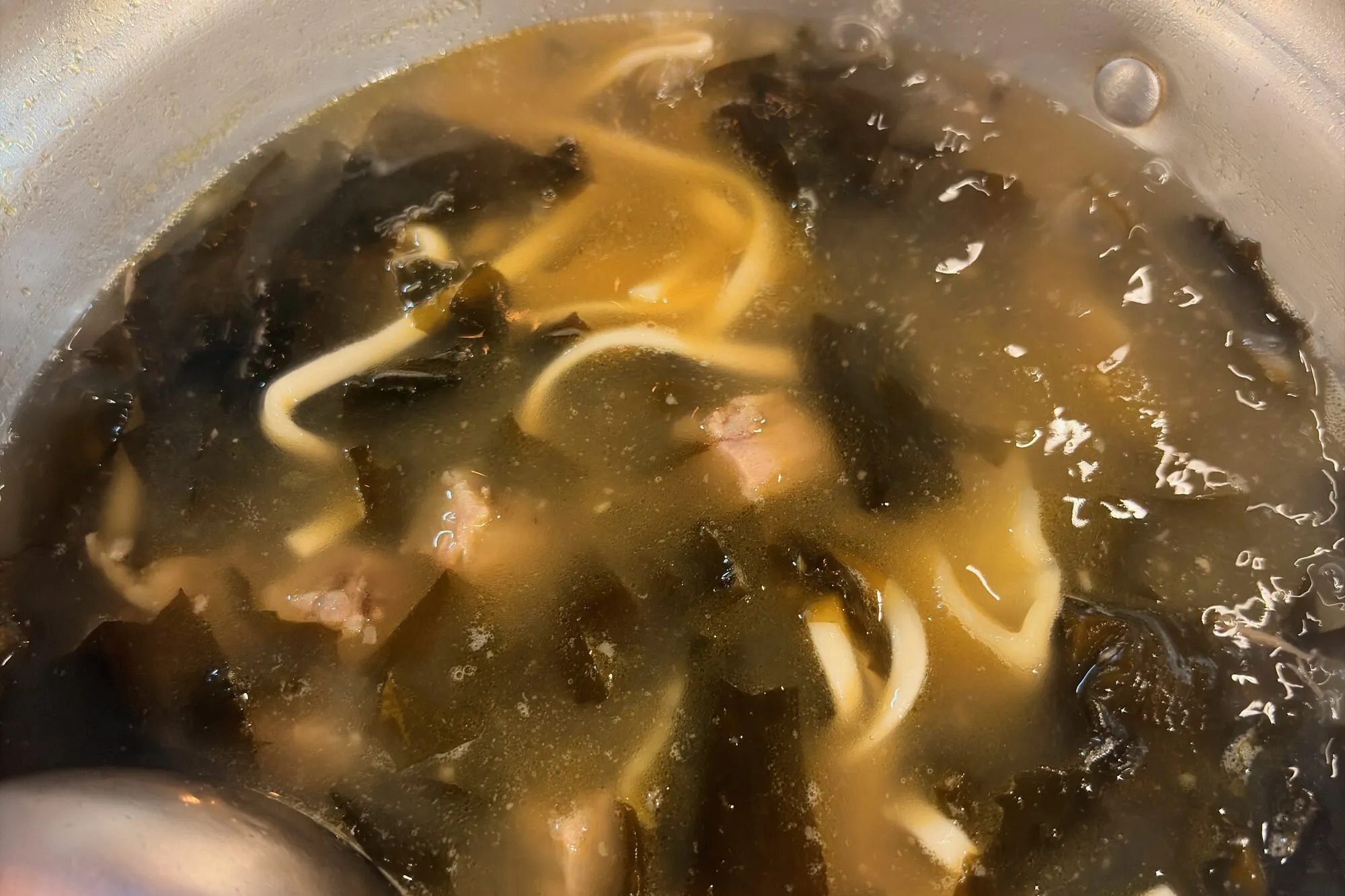
Is Silbiok worth it for a visitor?
Yes. It’s a place Koreans eat at: when I arrived at 6:50 p.m. on a Saturday the dining room was full and five teams were ahead of me on the waitlist. On Naver Place, the restaurant pages inside Naver Map, it averaged 4.87 from 1,977 star ratings on October 21. The wall above the kitchen is covered in signed messages from K-pop idols.
The main dish is built on seaweed soup, miyeokguk, which is Korean soul food: Koreans eat it on their birthdays, and our guide to miyeokguk explains why. Silbiok turns it into a hot pot. Nothing I ate was spicy, which makes it an easy first Korean meal.
What should you order at Silbiok?
Order the beef seaweed hot pot for the table, and add the squid salad with pan-fried dumplings.
Beef seaweed hot pot (소고기미역전골), ₩13,900 a serving (₩11,900 at weekday lunch), two servings minimum. It’s beef brisket with seaweed from Wando on Korea’s south coast, with hand-cut kalguksu noodles, sujebi and porridge to finish, all in the price. On the English menu it’s “Beef Seaweed Sujebi Stew (Meal)”. The pot arrives on a burner at your table with a plate of raw noodles and dough beside it.
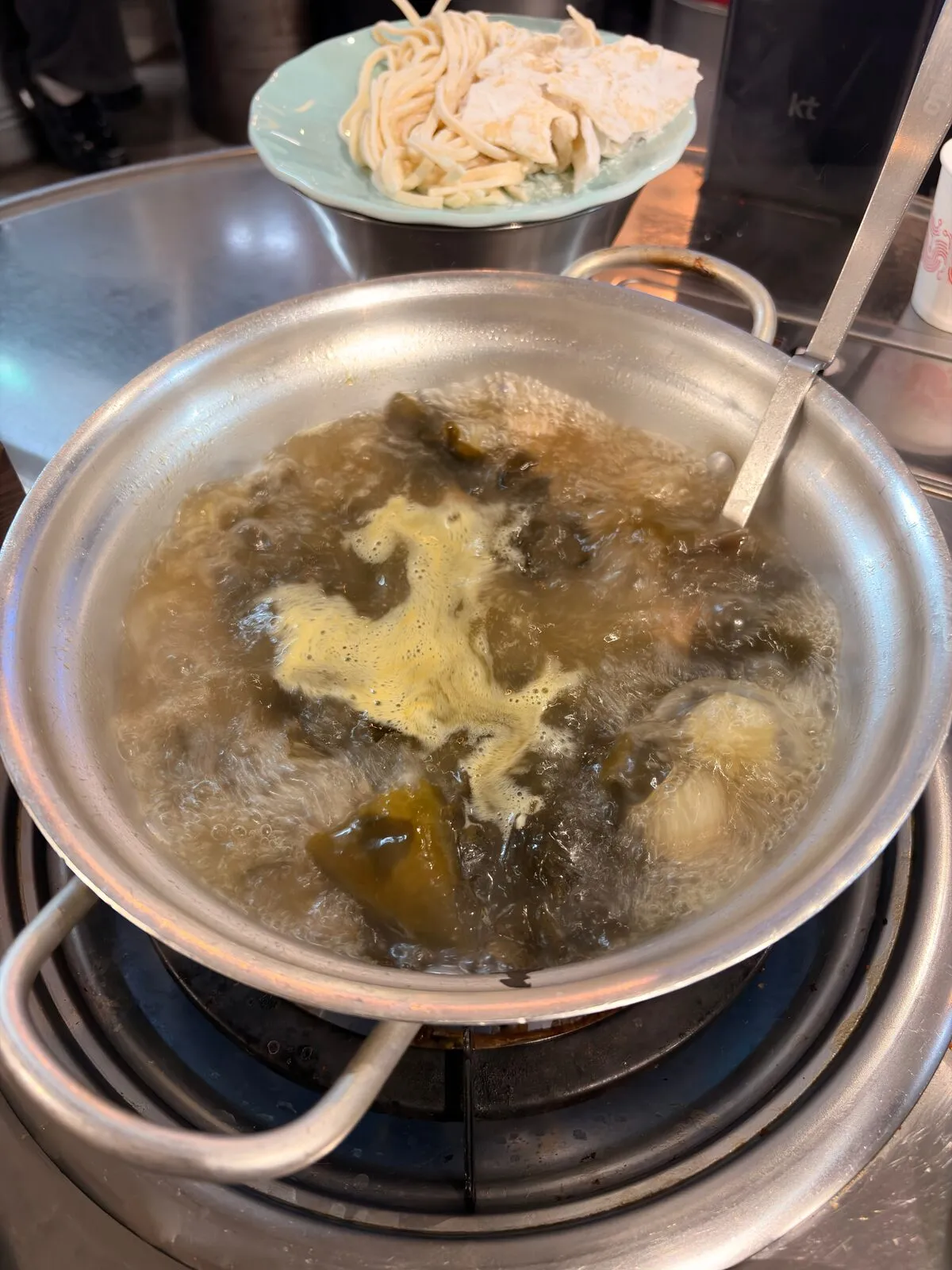
The hot pot on the burner, with the kalguksu noodles and sujebi dough waiting on the plate behind. Photo: Steve OH.
Eat it in three rounds:
- The soup. Eat the beef and seaweed while the broth boils.
- Noodles and sujebi. Drop the hand-cut kalguksu noodles and the torn sujebi dough into the broth and let them cook until soft.
- Porridge. A metal bowl comes with rice, chopped carrot, sliced green onion, sesame, a raw egg yolk and a little soy sauce. It goes into the last of the broth and cooks into a thick porridge (죽, juk).
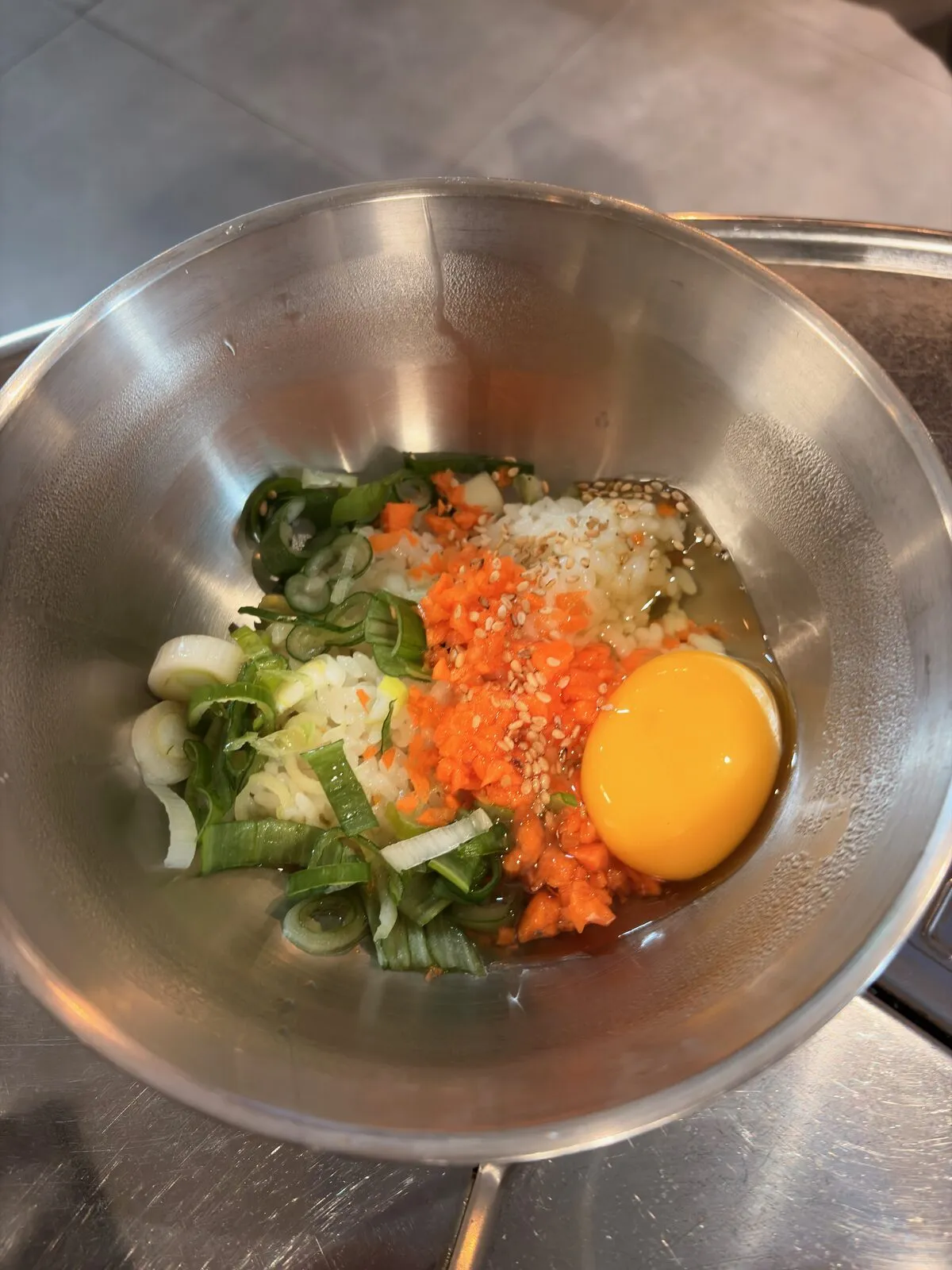
The bowl for the last round, before it goes into the pot. Photo: Steve OH.
The porridge does not look like much. It comes out thick and beige, flecked with seaweed, carrot and egg, but it tastes good.
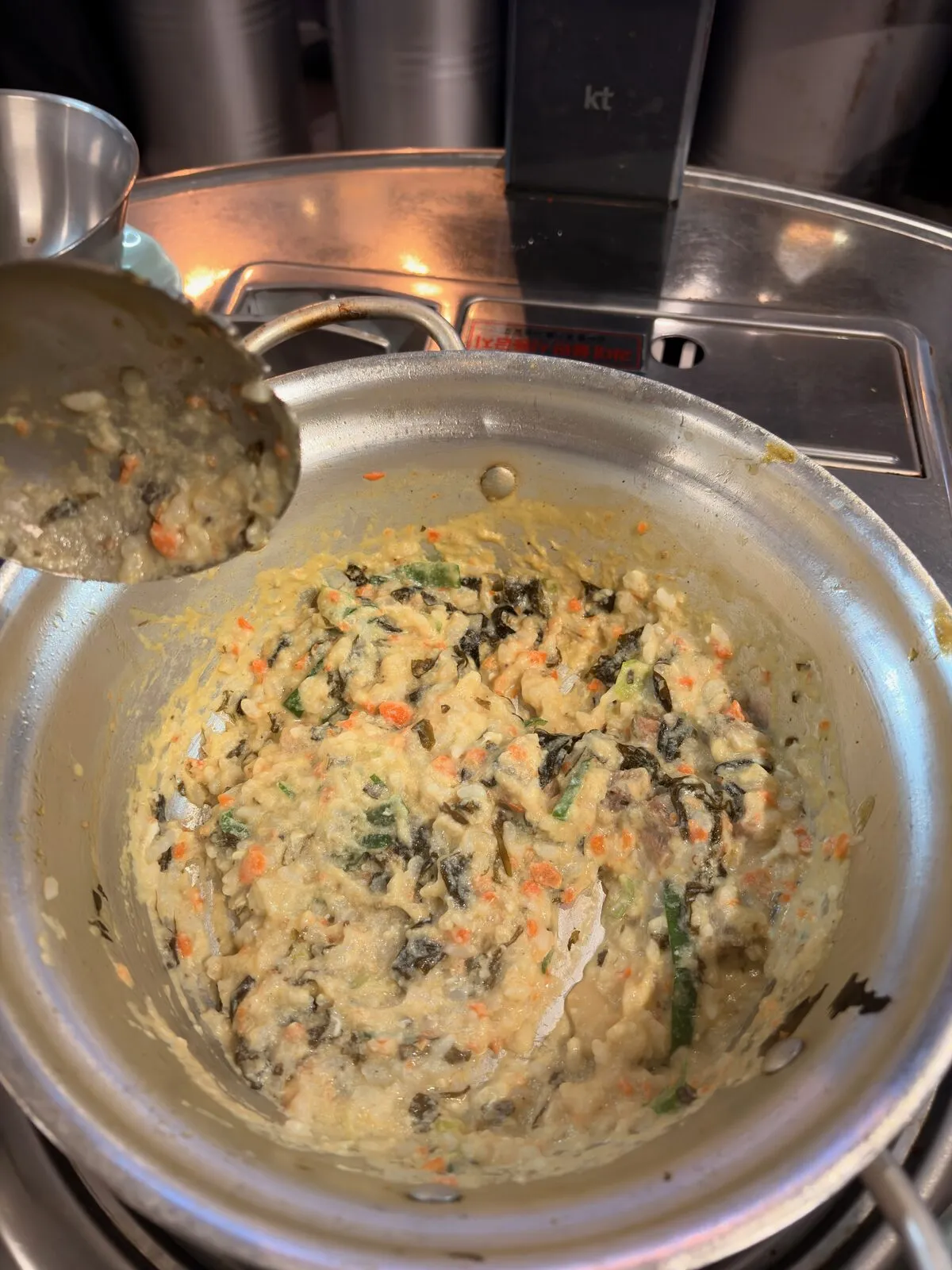
The porridge, cooked in the pot at the end of the meal. Photo: Steve OH.
Squid salad with pan-fried dumplings (오징어무침과 꾼만두), ₩15,000. Seasoned squid tossed with water parsley (minari) and sesame, served with three pan-fried dumplings. The dumplings were tasty, and the squid salad is seasoned exactly the way Koreans like it, but without the heat. I liked both. The posted English menu has no item by this name, so order it on the tablet by its Korean name.
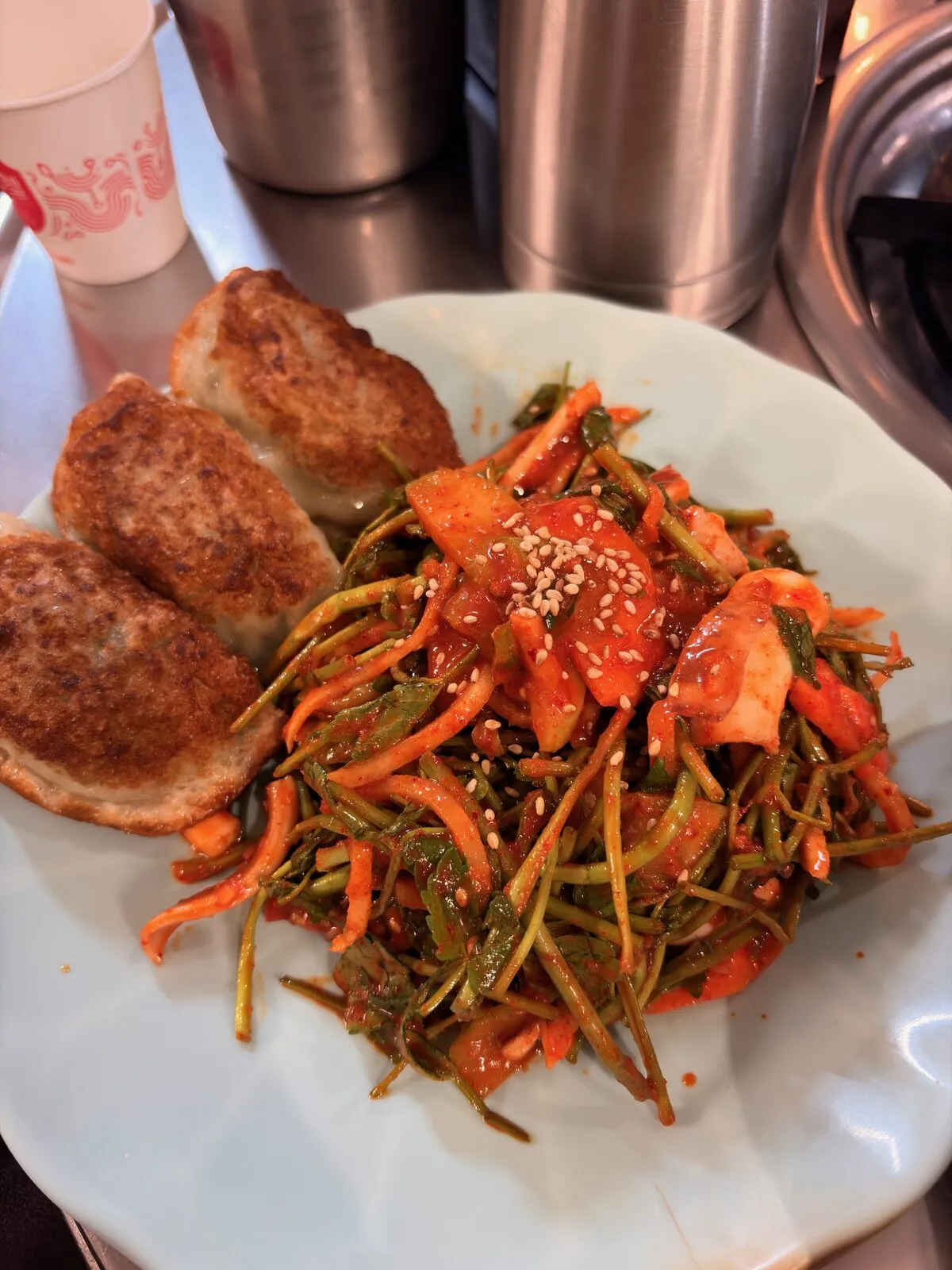
The squid salad with pan-fried dumplings. Photo: Steve OH.
The kkakdugi. The cubed radish kimchi (깍두기) is the textbook version, the way Koreans like it. If you enjoy this one, you will enjoy Korean kimchi in general.
The other two hot pots follow the same course. The LA galbi hot pot (소갈비전골, “LA Galbi Sujebi Stew” on the English menu) comes with LA-style short ribs, and the squid and water parsley hot pot (오징어미나리전골, “Squid & Water Parsley Sujebi Stew”) with squid. Each costs ₩14,900 at dinner and weekends and ₩12,900 at weekday lunch. I didn’t try them. If you are eating alone, the beef seaweed hot pot needs at least two servings, so order a single bowl of beef seaweed soup (소고기미역국) for ₩9,900 instead.
How much does Silbiok cost?
Two people eating the beef seaweed hot pot pay ₩27,800 at dinner or on a weekend, or ₩23,800 at weekday lunch; add the squid salad and it comes to ₩42,800 or ₩38,800. The weekday-lunch price is ₩2,000 off each hot pot. On October 17 the menu at the door gave its hours as 11 a.m. to 2 p.m., and the last weekday lunch order is at 2:20 p.m.
| Item | Weekday lunch (11 a.m.–2 p.m.) | Dinner and weekends |
|---|---|---|
| Beef seaweed hot pot (소고기미역전골), per serving | ₩11,900 | ₩13,900 |
| LA galbi hot pot (소갈비전골), per serving | ₩12,900 | ₩14,900 |
| Squid and water parsley hot pot (오징어미나리전골), per serving | ₩12,900 | ₩14,900 |
Soju and bottled beer cost ₩6,000, makgeolli ₩6,000 and a highball ₩8,000. On October 17 the menu at the door listed extra sujebi or kalguksu at ₩2,900 and three dumplings at ₩3,900 as add-ons for the pot.
When is Silbiok open?
Silbiok opens every day from 11 a.m. to 11 p.m., with last orders at 10 p.m. From Monday to Friday the last lunch order is at 2:20 p.m. and it closes for a break from 3 p.m. to 5 p.m.; on Saturday and Sunday it stays open all day.
How do you get to Silbiok?
Take Line 2 to Seongsu Station and leave by Exit 3; Silbiok is 171 m away, in the basement of THE LIV Sejong Tower (성수 더리브 세종타워). Go down the stairs from the ground floor, and the restaurant is immediately on your right, unit B107, behind a red 실비옥 sign.
- Address: B107, basement level 1, 126 Achasan-ro, Seongdong-gu, Seoul (서울 성동구 아차산로 126 지하1층 B107호)
- On a map: search 실비옥 in Naver Map; our Naver Map guide shows how to use it in English.
- Parking: the THE LIV Sejong Tower basement garage is free for the first 60 minutes, then ₩1,000 per 10 minutes, up to ₩30,000.
- Access: Naver Place lists a wheelchair-accessible entrance, seating and toilet.
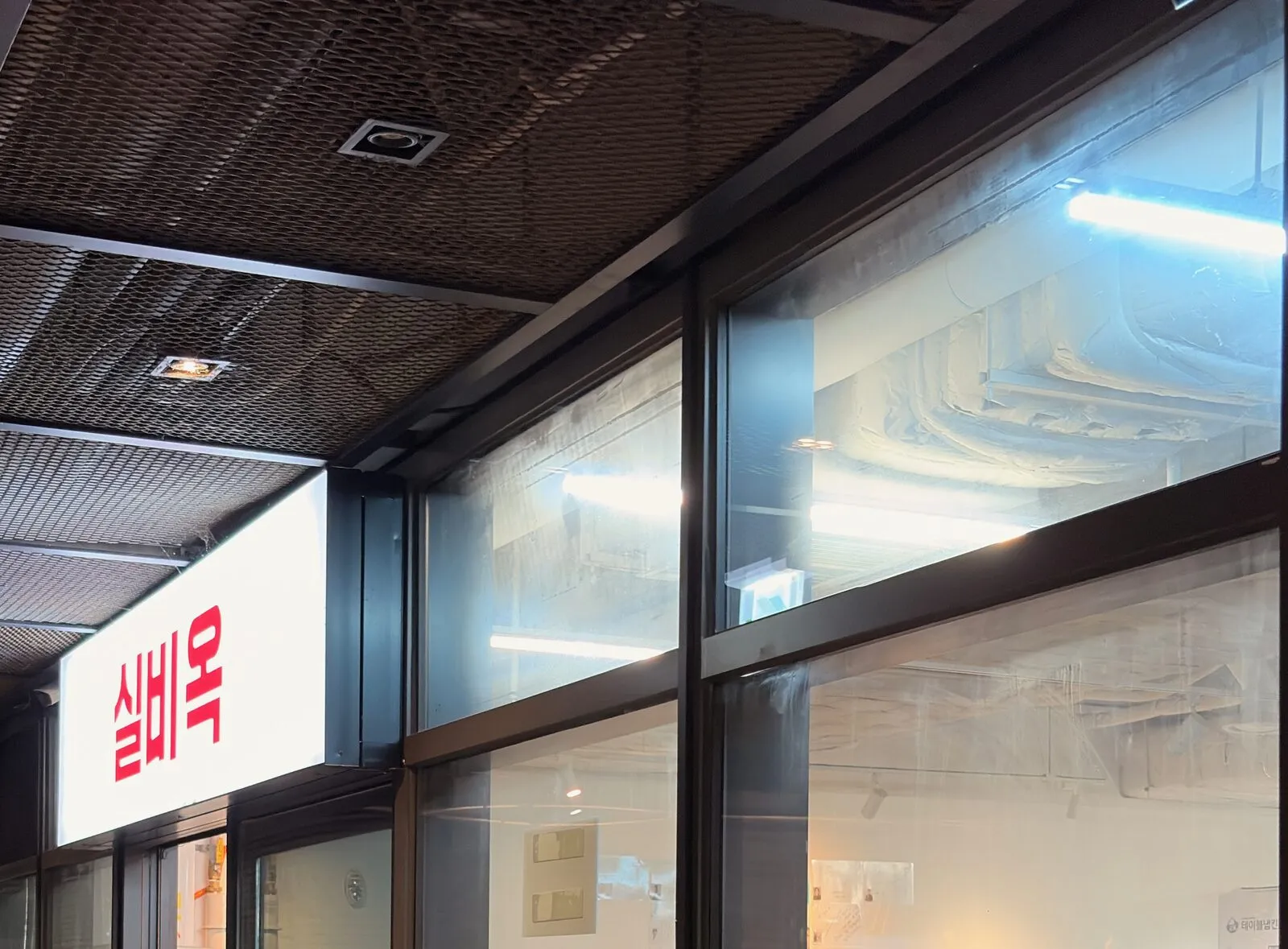
The red 실비옥 sign in the basement corridor of THE LIV Sejong Tower. Photo: Steve OH.
How does the waitlist at Silbiok work?
At busy times you join a waitlist on the Catchtable kiosk by the door, and it asks for a Korean mobile number starting with 010. When your turn comes, it sends an alert on KakaoTalk, and the alert lets you cancel or move back your place. The kiosk has a LANGUAGE button. Weekday lunch is the cheaper time to come. On Naver Place you can book only a group dinner for 4 to 20 people, on weekdays, paid in advance when you book; weekends cannot be booked there.
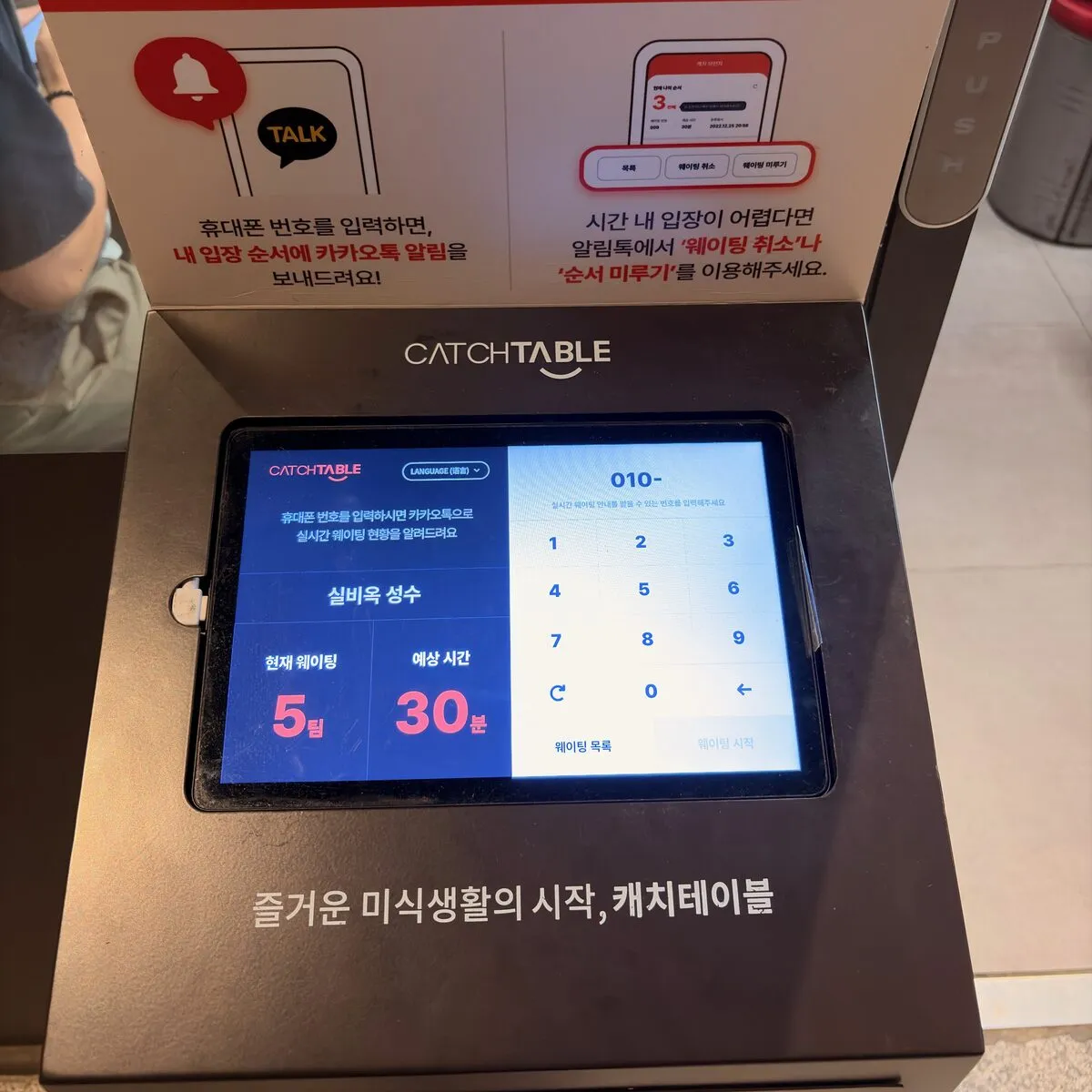
The waitlist kiosk at 6:50 p.m. on Saturday, October 17: five teams, 30 minutes. Photo: Steve OH.
The wait was shorter than the kiosk said: it showed 30 minutes, and we were seated and ordering about 12 minutes later. The alert comes through KakaoTalk, so set up KakaoTalk on that 010 number before you join the list. If you have no 010 number, a tourist SIM or eSIM with a voice line gives you one; our eSIM guide compares them.
How do you order at Silbiok?
You order on the tablet at your table. It has a LANG button and tabs for hot pots, sides, dishes, drinks, alcohol and takeout, plus a button to call staff. The menus posted at the door are in English, Chinese and Japanese.
If you post a Google review with a photo and show it to staff, the tablet offers free dumplings or a canned drink; I didn’t take it. I paid by card, and stickers on the door show KakaoPay, Zero Pay and Alipay+ are accepted too.
More Food & Drink
Food & Drink
Korean Convenience Stores: How GS25, CU, 7-Eleven and emart24 Work
Paying by card, the hot-water station for cup ramyeon, opening a triangle kimbap, 1+1 and 2+1 deals, the age rule for beer, and the ATMs, parcel kiosks and tax refunds some branches add.
Food & Drink
Neungdong Minari in Seongsu: Is the Minari Beef Soup Worth the Line?
I went on a Friday night in October and paid my own bill. How long the line really takes, what to order, what minari tastes like and who may not like it, prices, hours, takeout, and the walk from Seongsu Station Exit 4.
Food & Drink
Gwangjang Market Street Food: Hours, Dishes and How to Order
Hours, the walk from Jongno 5-ga Station, what bindaetteok, mayak gimbap, yukhoe and kalguksu are, how the stalls work, and how to avoid being overcharged.
Steve OH edits Seoulpin. Steve runs Standardpin, a Seoul-based web studio that also builds websites for clinics; that work has no effect on whether or how any clinic appears here. Articles are drafted with AI assistance from the sources listed and reviewed by Steve before publishing. How we work