Miyeokguk: Why Koreans Eat Seaweed Soup on Their Birthday
What is in Korea's seaweed soup, why it is the birthday breakfast and the first meal after a birth, why students skip it before an exam, and where a visitor gets to taste it in Seoul.
Koreans eat miyeokguk (미역국), a mild beef and seaweed soup, for breakfast on their birthday because it is the soup a new mother eats after giving birth. Eating it on your birthday is a way of honouring your mother. Tradition holds that it brings in her milk and gives back her strength, so it is her first meal after the birth and she keeps eating it for days or weeks. The soup is soaked miyeok, the brown seaweed sold elsewhere as wakame, simmered with beef brisket or shank and seasoned with soy sauce and sesame oil. It is savory and not spicy. Koreans avoid it before an exam or anything important, because slippery seaweed suggests “slipping”, which in Korean also means failing. In Seoul you can order it as a soup with rice and side dishes, at some jjimjilbang snack bars, and as a hot pot at Silbiok in Seongsu.
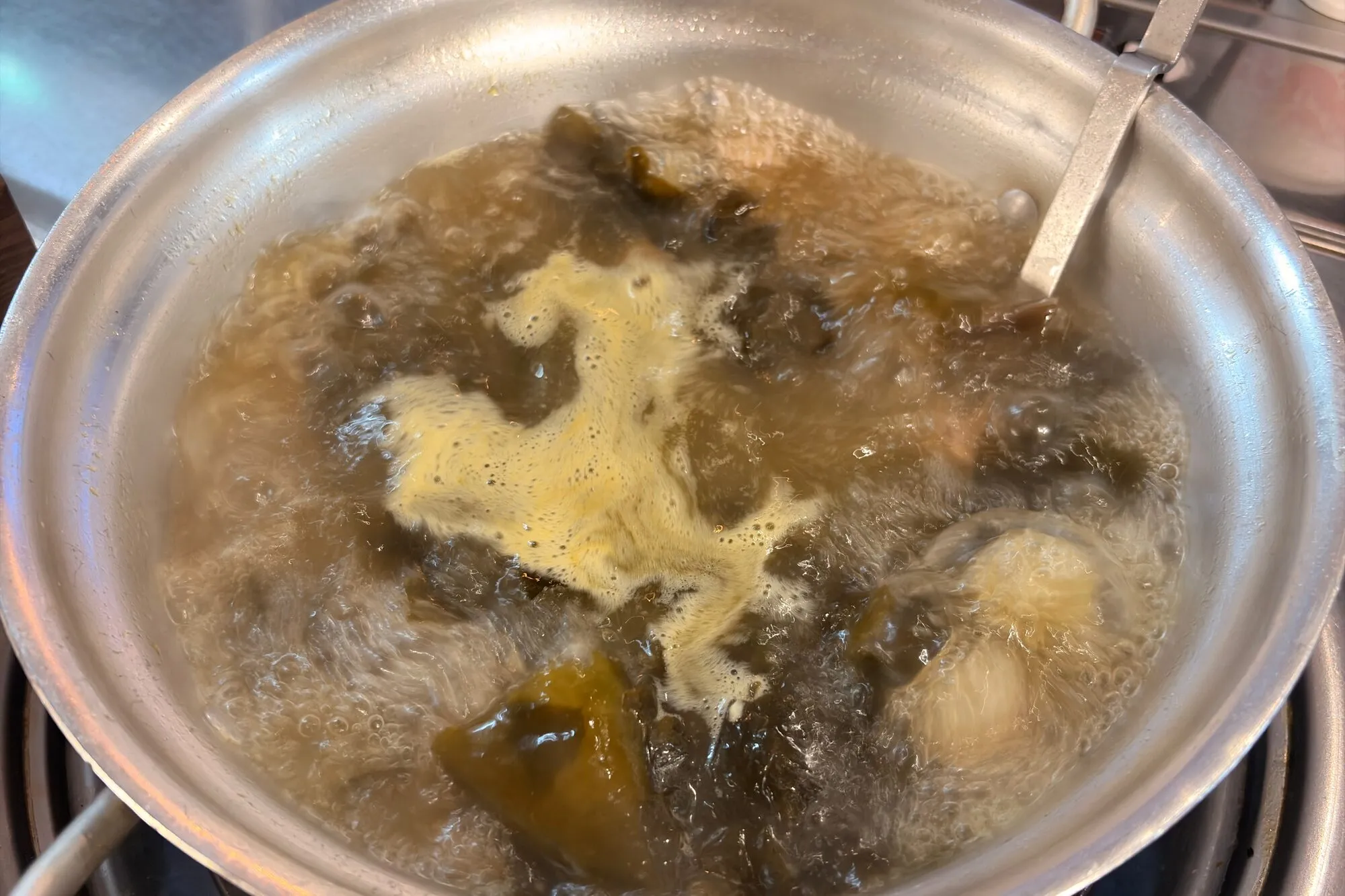
What is miyeokguk?
It is a clear or milky soup of seaweed and beef. Simmer beef brisket (yangjimeori) or shank until tender, add softened seaweed, season with soy sauce and finish with a little sesame oil. Fry the beef and seaweed in sesame oil before adding water and the broth turns milky; just boil them and it stays clear.
The seaweed is miyeok, Undaria pinnatifida. Koreans buy it dried, and dried miyeok swells up to ten times its size after 30 minutes in cold water. On English menus it is Seaweed Soup.
Why do Koreans eat seaweed soup on their birthday?
Because it is the soup a mother eats after giving birth, so your birthday bowl is a way of remembering what she went through to have you.
Most Koreans have miyeokguk with rice and side dishes on the morning of their birthday. The custom appears in newspapers in the 1930s and spread after the 1970s, when dried seaweed became plentiful.
Why do new mothers eat miyeokguk?
Because Korean tradition holds that seaweed soup brings in a new mother’s milk and gives back the strength she lost in labour, so it is her first meal after the birth and she keeps eating it for days or weeks. That first meal, cheotgukbap (첫국밥), the “first soup and rice”, began with a ritual: when labour began, the family set a small table in the room with seaweed, rice and soy sauce for Samsin, the household goddess of childbirth. After a safe birth, the seaweed and rice from that table were cooked into seaweed soup and a bowl of white rice, offered once more to Samsin, and only then eaten by the mother. The mother-in-law, the mother’s own mother or whoever was looking after her cooked it, sometimes the husband.
That first bowl had its own rules. It held no meat, only seaweed leaves in clear water seasoned with soy sauce and sometimes a little sesame oil, because Samsin was a pure spirit. From the second bowl on, beef or seaweed fried in oil was fine. Even buying the seaweed had customs: the family chose broad, long sheets, paid the asking price without haggling, and had them tied with straw rope rather than folded, because a folded strand was believed to bring a difficult birth.
The link between seaweed and birth goes back a long way: the Korean Culture and Information Service says visiting writers of China’s Tang dynasty (618 to 907) recorded that Koreans linked seaweed with childbirth after seeing whales eat it after calving.
Why shouldn’t you eat miyeokguk before an exam?
Because seaweed is slippery, and in Korean 미끄러지다 (mikkeureojida), “to slip”, also means to fail to be chosen, as in failing a state exam. People facing something important skip miyeokguk in case things slip away from them.
Korean even has an idiom for it: 미역국을 먹다, “to eat seaweed soup”, means to fail an exam, lose your job or be turned down. “I ate seaweed soup” (미역국 먹었어) is how Koreans say they failed. So don’t cook or offer seaweed soup to anyone the day before an exam or interview, and don’t joke that they will “eat seaweed soup”.
What kinds of miyeokguk are there?
Beef is the standard, but there are other versions:
- Beef (소고기미역국, sogogi miyeokguk). Brisket or shank with soy sauce and sesame oil, the version most people mean.
- Mussels (홍합미역국, honghap miyeokguk). Some cooks make it with dried mussels.
- Clams and white fish. On the coast people add clams or white fish such as sea bream or flatfish, and coastal homes also use flounder, tilefish and dried pollock.
- Chicken. The seaweed can also go into a chicken broth.
- With rice dumplings. Some Gyeonggi Province families add small balls of glutinous rice dough.
What does miyeokguk taste like, and is it spicy?
It is not spicy. There is no chili in it: it is seasoned with soy sauce, garlic, black pepper, sesame oil and salt. The broth tastes of beef and the sea, savory and lightly salty, with the nutty smell of sesame oil. The seaweed is soft and slippery, not crunchy.
If you find Korean food fiery, this is a safe soup to order, and it is a good first taste of Korean home cooking.
Where can you eat miyeokguk in Seoul?
Look for 미역국 (Seaweed Soup) or 소고기미역국 (Beef and Seaweed Soup) on a Korean menu, or a set of seaweed soup with rice, 미역국밥 (miyeokgukbap). To find one near you, search 미역국 in Naver Map; our Naver Map guide shows how to use it in English.
| On the menu | Romanized | Official English name |
|---|---|---|
| 미역국 | Miyeokguk | Seaweed Soup |
| 소고기미역국 | Sogogimiyeokguk | Beef and Seaweed Soup |
| 홍합미역국 | Honghapmiyeokguk | Mussel and Seaweed Soup |
A few other ways to try it:
- As a hot pot at Silbiok (실비옥), near Seongsu Station Exit 3. Order the beef and seaweed hot pot (소고기미역전골) and eat it as a course: the soup first, then noodles cooked in the broth, then porridge made in the same pot. Our Silbiok review has the prices, hours, two-serving minimum and waitlist.
- At a jjimjilbang. Some bathhouse snack bars serve seaweed soup. Our jjimjilbang guide explains how the snack bar and wrist-key payment work.
- In instant form. Seaweed soup also comes as instant noodles and cup soup, and any of them can be made at a convenience store’s hot-water station (see our convenience store guide).
How do you make miyeokguk at home?
It takes about an hour, half of it soaking the seaweed. This is the Korea.net recipe, made with 8 cups (1.6 litres) of water:
- Soak 20 g of dried seaweed in water for 30 minutes, rinse off any sand, squeeze it out and cut it into 4 cm strips.
- Cut 100 g of beef shank into thin bite-size squares and season with ½ teaspoon of soup soy sauce (국간장, guk-ganjang), ½ teaspoon of minced garlic and a pinch of black pepper.
- Heat 1 tablespoon of sesame oil in the pot, stir-fry the beef for 2 minutes over medium heat, add the seaweed and fry for 3 minutes more.
- Pour in 8 cups of water, boil hard for 5 minutes, then simmer on medium for 20 minutes.
- Season with 1 teaspoon of soup soy sauce and 2 teaspoons of salt (adjust to taste), and bring it back to the boil.
More K-Culture
K-Culture
Changdeokgung Secret Garden Tickets and Entry Times
The garden needs its own timed ticket on top of palace admission, and the timed entry is at an inner gate 15 minutes' walk from the main gate. How to book, what it costs, the English sessions and how early to arrive.
K-Culture
Deoksugung: The Palace Where Korea Tried to Become a Modern Empire
Why a Joseon palace has a neoclassical stone hall, the buildings worth your time, the free English tours, the Seokjojeon museum you can only see with a guide, the guard change at Daehanmun, and the late hours that let you visit after dark.

K-Culture
Gyeongbokgung in Hanbok: What Gets You In Free, and What Doesn't
The dress code behind free palace entry, what Seoul's royal palaces and Jongmyo charge everyone else, when the guards change, how night-viewing tickets work, and how to judge a hanbok rental before you pay.
Steve OH edits Seoulpin. Steve runs Standardpin, a Seoul-based web studio that also builds websites for clinics; that work has no effect on whether or how any clinic appears here. Articles are drafted with AI assistance from the sources listed and reviewed by Steve before publishing. How we work