Templestay in Seoul: Day Programmes and Overnight Stays in English
From a free tea with a monk opposite Jogyesa to a weekend night at Bongeunsa with a 4:20 a.m. dawn ceremony and 108 prostrations: what six Seoul temples charge for English templestays, which days they run and how to book and cancel on templestay.com.
Six temples in Seoul run English templestays that individual travellers can book on templestay.com, the official booking site. Day programmes last one to six hours and cost ₩5,000 to ₩50,000; a 50-minute tea with a monk opposite Jogyesa is free. Overnight stays cost ₩80,000 to ₩120,000 a person, run from early afternoon to mid-morning the next day, and include dinner, breakfast, the evening and dawn ceremonies and a temple uniform. Bongeunsa’s Saturday-to-Sunday stay runs on selected Saturdays, about once a month, and online booking closes one to three days before, depending on the temple.
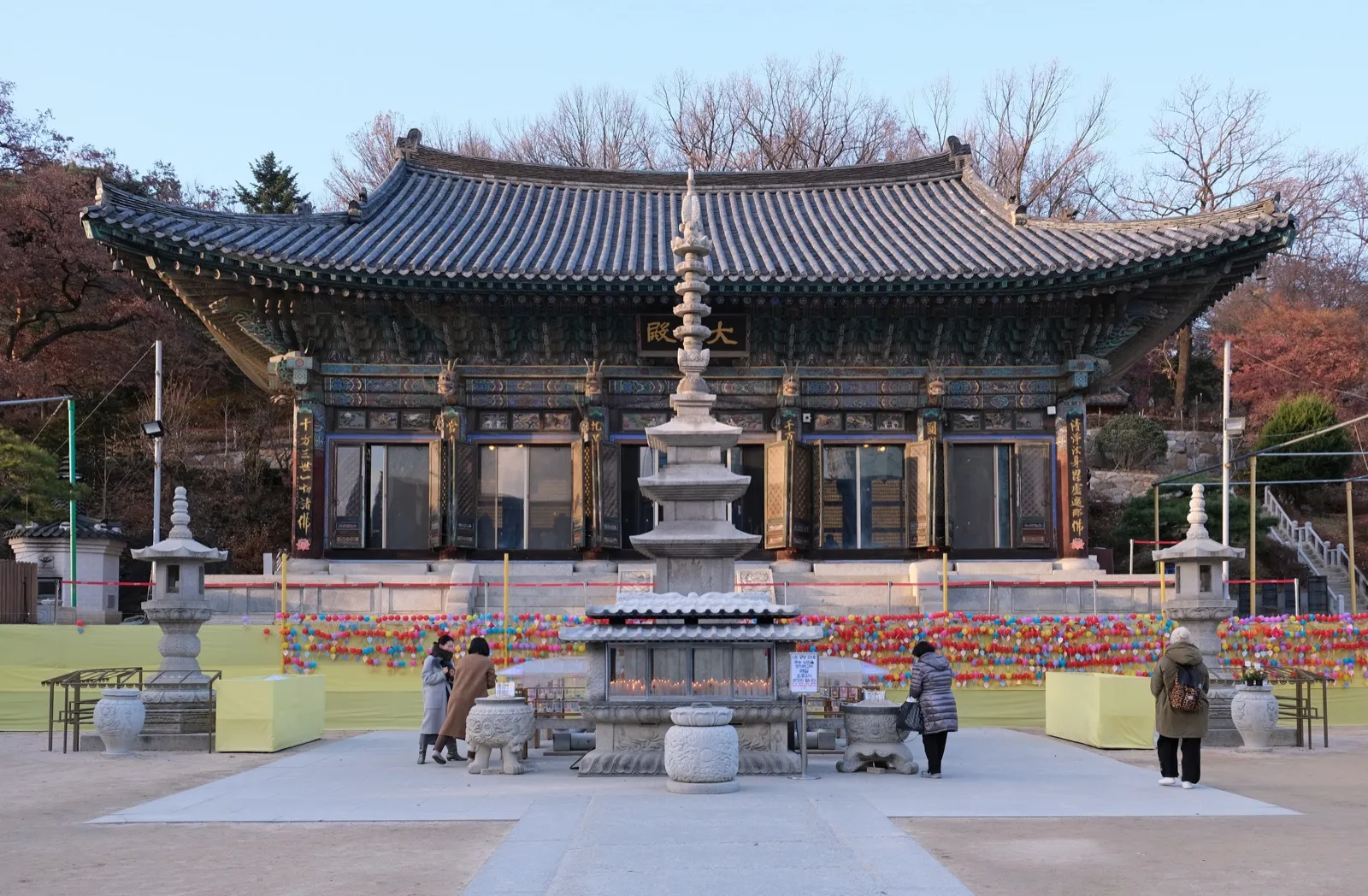
Which temples in Seoul run templestay in English?
Bongeunsa, Geumsunsa, Hwagyesa, Jogyesa, Myogaksa and the International Seon Center all had English programmes open to individual travellers in the Seoul programme list on October 16, 2026. The templestay.com FAQ names these six and Jinkwansa as the Seoul temples you can reach by bus or subway.
| Temple | District | Getting there | English programmes |
|---|---|---|---|
| Jogyesa | Jongno-gu | Jonggak Station (Line 1) Exit 2, then 300 m; or Anguk Station (Line 3) Exit 6, then about 300 m | Morning tour, tea ceremony, overnight |
| Bongeunsa | Gangnam-gu | Bongeunsa Station (Line 9) Exit 1, then 100 m; or Samseong Station (Line 2) Exit 6, then 600 m | Tuesday drop-in, Thursday afternoon, Sunday evening, Saturday–Sunday overnight |
| Geumsunsa | Jongno-gu, a mountain temple | Bus 7212 to the Yibukodocheung stop, then about 20 minutes on foot and 200 m up a trail | Overnight rest stay |
| Myogaksa | Jongno-gu | Dongmyo-ap Station (Lines 1 and 6) Exit 2, turn left, 50 m to a signposted path, then uphill | One day, overnight |
| International Seon Center | Yangcheon-gu | Omokgyo Station (Line 5) Exit 8, about 650 m, 8 to 10 minutes | Day meditation, free Saturday evening, overnight |
| Hwagyesa | Gangbuk-gu | Bus 151, 121 or 1165 to the Hanshin University stop, then about 5 minutes uphill; or Suyu Station (Line 4) Exit 3, then green bus 02 to the same stop | Overnight |
Myogaksa runs its overnight stay “in English or translated in English”, and the International Seon Center’s Saturday evening is held in English.
For Geumsunsa, take bus 7212 (pay with a T-money card) from Gyeongbokgung Station Exit 3, Gwanghwamun Station Exit 2 or Bulgwang Station Exit 2, get off at the Yibukodocheung stop, walk about 900 m towards the mountain, then hike about 200 m and turn left at the crossroads with the toilets on your right. A small cable car carries luggage only from the parking area to the templestay office; ask the temple in advance if you need it. For Hwagyesa, a taxi from Suyu Station Exit 7 is the easiest way. Plan both bus rides on Naver Map or Kakao Map.
Other English listings are left out below. Jinkwansa’s half-day programme may be cancelled if fewer than 15 people book and had no open dates on October 16; Jogyesa’s “Be a true hero!” takes groups of 10 or more; Doseonsa’s “Onnuri” is for children’s centres and welfare organisations; and two listings were about to end: Bongeunsa’s ₩80,000 Five Elements Yin Yoga Night, whose last date is October 23, and Hwagyesa’s Only Rest overnight, listed until October 31.
What is the difference between a one-day programme and an overnight templestay?
A one-day programme is a few hours at the temple with no night there; an overnight stay sleeps you in the temple and follows its timetable from the evening ceremony to the dawn ceremony. One-day programmes are usually two or three hours of temple tour, meditation and tea ceremony. Overnight programmes are either “experience-oriented”, typically one weekend night with the dawn ceremony, 108 prostrations (a full bow, repeated 108 times), a monastic meal and meditation, or “rest-oriented”, where you mostly rest and join the ceremonies and meditation.
Only an overnight stay includes the 4 a.m. wake-up and the dawn ceremony; the closest a day programme comes is Bongeunsa’s Sunday evening programme, which ends with the evening ceremony.
How much does a templestay in Seoul cost?
Day programmes cost ₩5,000 to ₩50,000 and overnight stays ₩80,000 to ₩120,000 a person; at most temples children pay the same as adults, and the tea with a monk (below) is free. The tables list the main programmes individual travellers could book on October 16, 2026, with the days shown on each programme page or its booking calendar that day.
Day programmes
| Programme | When | Price | What you do |
|---|---|---|---|
| Bongeunsa BONG-PASS | Tuesdays, 10 a.m. to 4 p.m., drop in | ₩5,000 (free for preschoolers) | Tea, meditation and rest at the templestay centre at your own pace, no guide |
| Bongeunsa Twilight Resonance | Sundays, 5 to 7 p.m. | ₩5,000 | Temple tour, the four Buddhist instruments, evening ceremony |
| Jogyesa Always Templestay | Monday to Saturday, 10 to 11:20 a.m. | ₩10,000 | Temple tour, making a paper lotus lantern |
| Bongeunsa Thursday programme (Temple Tour & Tea or Buddhist Culture) | Thursdays, 2 to 4 p.m. | ₩30,000 | Temple tour plus either a tea ceremony or singing-bowl sound meditation and sutra copying, on different Thursdays |
| International Seon Center day programme | Selected dates, 10 a.m. to 2 p.m. | ₩30,000 | Seon meditation, lunch, lotus lantern, tea and questions with a monk |
| Jogyesa Seon of Tea | Selected Mondays, 2:50 to 4:40 p.m. | ₩50,000 | Hour-long tea ceremony with a tea instructor, temple tour |
| Myogaksa one day | Selected dates, 9:30 a.m. to 2 p.m. | ₩50,000 | 108 prostrations while making 108 wooden beads, meditation, lunch, tea ceremony |
Overnight stays (one night, two days)
| Programme | Days and check-in | Price | Highlights |
|---|---|---|---|
| Jogyesa Regular Templestay | Selected Tuesdays to Thursdays, 1:30 p.m. | ₩80,000 | Lotus lantern, tea with a monk or sutra copying, optional 108 prostrations and dawn ceremony |
| Geumsunsa Relaxational Templestay | Tuesdays to Thursdays, by 2:30 p.m. | ₩80,000 adult, ₩70,000 teenager, ₩60,000 child | Drum and bell, evening and dawn ceremonies, singing bowl meditation, free time |
| International Seon Center Luminous Lotus | Selected dates, 2 p.m. | ₩90,000 | Lotus lantern, wrist beads, evening meditation, 108 prostrations at dawn, tea with a monk |
| International Seon Center Engraving Serenity | Selected dates, 2 p.m. | ₩90,000 | Writing Buddhist phrases on a fan, pressed-flower paper or a lamp, wrist beads, evening meditation, 108 prostrations at dawn, tea with a monk |
| Hwagyesa Only Don’t Know | Selected dates, 1:20 p.m. | ₩90,000 | Walking meditation, ringing the big bell, 108 beads, tea with a monk |
| Myogaksa Where Is Your Mind? | Selected dates, 2 p.m. | ₩95,000 | 108 prostrations with bead making, bell striking, intensive dawn meditation, tea with a monk |
| Jogyesa Seon of Tea overnight | Selected dates, 1:30 p.m. | ₩100,000 | Tea ceremony with a tea instructor, lotus lantern, optional 108 prostrations and dawn ceremony |
| Bongeunsa Regular Templestay | Selected Saturdays (about once a month), 1:50 p.m. | ₩120,000 | Evening ceremony, self-meditation, dawn ceremony at 4:20 a.m., 108 prostrations, tea with a monk |
Hwagyesa’s listed operating period ends on November 30, 2026.
What happens during an overnight templestay?
You arrive in the early afternoon, change into a temple uniform, eat dinner from about 4:30 p.m., go to bed around 9 p.m. and get up around 4 a.m. for the dawn ceremony. This is the Jogyesa timetable, which the temple says may change:
| Time | Day 1 |
|---|---|
| 1:30 p.m. | Meet at the information office, left of the main entrance; check in, change into uniform |
| 1:40 p.m. | Orientation and temple etiquette |
| 2:20 p.m. | Paper lotus lantern |
| 3 p.m. | Tea with a monk (five or more guests) or copying Buddhist teachings (fewer than five) |
| 3:50 p.m. | Temple tour |
| 4:30 p.m. | Monastic dinner, until 5:45 p.m. |
| 5:55 p.m. | Dharma instruments and evening ceremony (optional) |
| 7 p.m. | 108 prostrations (optional) |
| 9 p.m. | Bedtime |
| Time | Day 2 |
|---|---|
| 4 a.m. | Wake up to the Dharma instruments |
| 4:25 a.m. | Dawn ceremony with a monk (optional) |
| 5 a.m. | Walking meditation (optional) or rest |
| 7 a.m. | Breakfast |
| 10 a.m. | Check-out |
You sleep in a shared room, with men and women in separate rooms (see the room rules below). Geumsunsa puts people who book together in the same room, Myogaksa gives each guest a locker and bedding, and at Bongeunsa you fold your own bedding and clean the room before you leave.
Bongeunsa’s weekend stay marks none of its sessions as optional: the timetable has lights out at 9 p.m., the dawn ceremony at 4:20 a.m., 108 prostrations at 5 a.m. and tea with a monk at 9 a.m., ending at 11 a.m. on Sunday. The FAQ says you may rest in your room instead of joining a session if you feel unwell or too tired; tell the staff.
Is there a free templestay in Seoul?
Yes: a free 50-minute tea with a monk at the Templestay Information Center, opposite Jogyesa. On October 16, 2026 its calendar showed sessions mostly on Fridays, Saturdays and Sundays at 2:30 and 3:40 p.m. Each time slot is a separate listing on templestay.com (2:30 p.m., 3:40 p.m.; 10:20 a.m. and 1:20 p.m. run on a few Fridays). The centre also runs a free Saturday tea meditation at 10:20 a.m. for up to four people per session; tell the monk beforehand if you are allergic to a tea or sensitive to caffeine.
The centre is on the first floor of the Templestay Center, 56 Ujeongguk-ro, Jongno-gu, directly across the street from Jogyesa, so either place’s directions work (the tea listings give Jonggak Station Exit 3-1, about 350 m, or Anguk Station Exit 6, about 250 m). It opens daily from 9 a.m. to 6 p.m. and closes on New Year’s Day and over the Lunar New Year and Chuseok holidays. Staff there answer questions in person and hand out brochures, so it is also the place to ask which temple suits you. The fifth floor has Balwoo Gongyang, a temple-food restaurant.
The International Seon Center runs a free English meditation evening with a dhamma talk every Saturday from 6:30 to 9 p.m. (donations recommended; book by the day before). Beginners must arrive by 6:30 p.m. for a 30-minute orientation; bring comfortable clothes, a cup and socks.
How do I book a templestay on templestay.com?
Open the Seoul programme list, pick a programme and a date on its calendar, set the number of people and press Reservation; the site then asks you to sign in, with a templestay.com account or with Google or Facebook. You do not need to print a confirmation, because each temple works from its own reservation list.
Book as soon as your date opens. Bongeunsa says reservations open one month before the date and Myogaksa says they usually do, but on October 16, 2026 Bongeunsa’s weekend calendar already listed December 5, seven weeks out, and every date shown on both Myogaksa calendars was fully booked.
Can I cancel a templestay and get a refund?
Yes, in full if you cancel at least three or four days ahead at most Seoul temples; Jogyesa needs seven days and Bongeunsa 14, and nothing is refunded on the day. To cancel or change a date, contact the temple or email support@templestay.com.
| Temple | Book by | Pay | Full refund | Partial refund | No refund |
|---|---|---|---|---|---|
| Jogyesa | 3 days before | When booking, by card online (recommended, on a computer) or by bank deposit; unpaid bookings are cancelled automatically, and cards are not taken on the spot | 7 or more days before | — | 1 to 6 days before |
| Bongeunsa weekend stay | 1 day before | Not stated on the listing | 14 days before | 70% at 7 days before | 6 days before or later |
| Bongeunsa Thursday | 1 day before | When booking, or ₩30,000 in cash only to the volunteer in the pink vest | 14 days before | 70% at 7 days before | 6 days before or later |
| Bongeunsa Sunday evening | Not stated | Not stated | 2 weeks before | 75% at 1 week before | Within a week |
| Bongeunsa BONG-PASS | Not stated | Card or cash on arrival | Not stated | Not stated | Not stated |
| Geumsunsa | 1 day before | Card or cash on arrival | 4 days before | — | 3 days to 1 day before |
| Myogaksa | Not stated | Cash at the temple or bank transfer | 3 days before | 50% at 2 days before | 1 day before or on the day |
| International Seon Center | 3 days before | Cash on arrival, bank transfer or card | 3 days before | 50% at 2 days, 10% at 1 day before | On the day |
| Hwagyesa | 2 days before | Cash or card at the temple | 3 days before | — | 2 days or 1 day before, but you can postpone; the day itself counts as attending |
Book the International Seon Center at least three days ahead: the site accepts day-programme bookings until two days before, but the centre admits only guests who reserved three days ahead.
Some programmes depend on numbers. Myogaksa cancels if no more than five people have booked four days before, and emails you if it does. Jogyesa’s overnight and Seon of Tea programmes may also be cancelled if too few people book. Bongeunsa runs its two Thursday programmes on different weeks, and either can switch to the other, at the same time and price, if too few people book. Bongeunsa says it restricts later templestay bookings for guests who do not show up without telling the temple.
What should I wear and bring to a templestay?
Wear modest, neat clothes and bring socks; temples provide a uniform for overnight stays, and most supply only soap and toothpaste, so bring a towel and toiletries unless your temple says otherwise. Jogyesa, Myogaksa, Hwagyesa and the International Seon Center advise against sleeveless shirts and flip-flops; Geumsunsa does not allow them, or sandals. Bongeunsa does not allow bare feet in its halls, so pack socks even for a day programme.
- Provided. Overnight stays include a uniform of vest and trousers at Jogyesa, Bongeunsa, Geumsunsa, Hwagyesa and the International Seon Center (a vest only on Jogyesa’s tea overnight); Myogaksa provides a uniform. Jogyesa provides soap, a towel and a hair dryer; Myogaksa provides bedding, a towel, soap, shampoo, body wash, toothpaste and a hair dryer; Bongeunsa provides only soap, a hair dryer and tissues.
- Bring. Toiletries, a towel where none is provided, socks, a T-shirt to wear under the uniform, comfortable shoes that slip on and off easily, loose clothes for sleeping and a water bottle; Bongeunsa also suggests a tumbler and an umbrella.
- Winter. Bring a jacket or sweater, because mountain temples are colder than you might expect. Geumsunsa is a mountain temple.
What are the rules during a templestay?
You may not drink alcohol or smoke anywhere in the temple, and you should keep silent near the halls. The International Seon Center and Jinkwansa also ban outside food, and Myogaksa bans food in the sleeping quarters. The Bongeunsa guidelines ask you to greet people with palms together and a half-bow (hapjang), walk with your hands folded in front of you (chasu), eat in silence without commenting on the food, take only what you can finish, avoid heavy make-up and strong scents, and return the uniform before you leave. The International Seon Center closes its doors from 10 p.m. to 4 a.m.
Do I need to be Buddhist, and can couples share a room?
No. Bongeunsa says it welcomes everyone regardless of nationality, belief, age or gender. Rooms are shared and separated by sex, even for couples, as the FAQ says; some temples rent private rooms for two to four people for an extra fee. Jogyesa puts families and groups together in three- or six-person rooms and separates couples, except parents with minor children; a private room costs extra and must be requested and paid in advance, never on the day.
Which Seoul templestay should I choose?
For a first overnight stay on a weekday, choose Jogyesa: its ceremonies and 108 prostrations are optional and it is a short walk from Jonggak and Anguk stations. At a weekend, choose Bongeunsa, the one stay that always runs from Saturday to Sunday and keeps every session in the schedule. For a few hours, take the free tea with a monk across the street from Jogyesa.
- A few hours between sights: the free tea with a monk at the Templestay Information Center from Friday to Sunday, or Jogyesa’s ₩10,000 morning programme or ₩50,000 afternoon tea ceremony across the street. Anguk Station Exit 6 is also the way to Bukchon, and you can pair the temple on the same day with Changdeokgung’s Secret Garden or Jongmyo.
- The full monastic routine: Bongeunsa’s weekend stay or Myogaksa’s overnight, which both put 108 prostrations in the core schedule. Book as soon as dates open.
- A mountain temple inside Seoul: Geumsunsa, in the hills of Jongno-gu, with long free-time blocks and Tuesday-to-Thursday overnight dates. The bus to it leaves from Gyeongbokgung Station Exit 3 and check-in is by 2:30 p.m., so you can spend the morning at Gyeongbokgung first.
- Meditation: the International Seon Center, whose day programme teaches posture and method, whose overnight guests join the evening meditation, and whose Saturday evening is free.
More K-Culture
K-Culture
Changdeokgung Secret Garden Tickets and Entry Times
The garden needs its own timed ticket on top of palace admission, and the timed entry is at an inner gate 15 minutes' walk from the main gate. How to book, what it costs, the English sessions and how early to arrive.
K-Culture
Deoksugung: The Palace Where Korea Tried to Become a Modern Empire
Why a Joseon palace has a neoclassical stone hall, the buildings worth your time, the free English tours, the Seokjojeon museum you can only see with a guide, the guard change at Daehanmun, and the late hours that let you visit after dark.
K-Culture
Gyeongbokgung in Hanbok: What Gets You In Free, and What Doesn't
The dress code behind free palace entry, what Seoul's royal palaces and Jongmyo charge everyone else, when the guards change, how night-viewing tickets work, and how to judge a hanbok rental before you pay.
Steve OH edits Seoulpin. Steve runs Standardpin, a Seoul-based web studio that also builds websites for clinics; that work has no effect on whether or how any clinic appears here. Articles are drafted with AI assistance from the sources listed and reviewed by Steve before publishing. How we work